If you've read my report on the FTW Ranch shooting experience, you'll know what the First Most Fun thing is. If not, I'm not telling you here.
But hands down the second most fun thing is feral pig hunting from a helicopter.
I had arranged for a two-hour helicopter pig hunt for three people through Gabe Fraire of Extreme Hog Hunting (https://extremehoghunting.com). Our reservation was for December 21, 2025, beginning at around 7:30 a.m. We met at a predetermined location in Scurry, Texas that was within a 9,000-acre parcel of land. We rendezvoused with Gabe and our pilot, Luke, who had trailered his Robinson R44 helicopter to our location from Austin where he operates Austin Heli Tours (https://austinhelitours.com). Everyone got a safety briefing and we were also told what the hunting process would be like. We also had an orientation to the suppressed AR-15's that we would be using as these, along with unlimited ammo, are supplied as part of the hunting package. We learned that Luke, our pilot, had been a key search and rescue pilot during the horrific Guadalupe River flooding of July 4, 2025, that killed 27 girls at Camp Mystic down in Hunt, Texas as well as 146 people overall. Luke was credited with numerous rescues and victim recoveries during that tragic event.
Round 1
My friend Jeff Houston and I were the first to get in the helicopter which is capable of handling two shooters at a time, both on the port (left) side of the helicopter. In this way, the pilot can position the shooters over the targets and all gunfire is in a single direction.
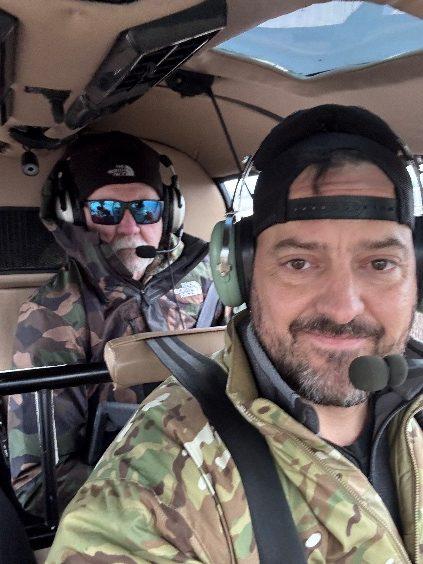
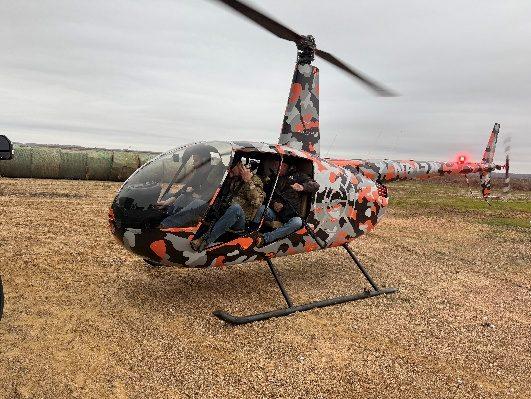
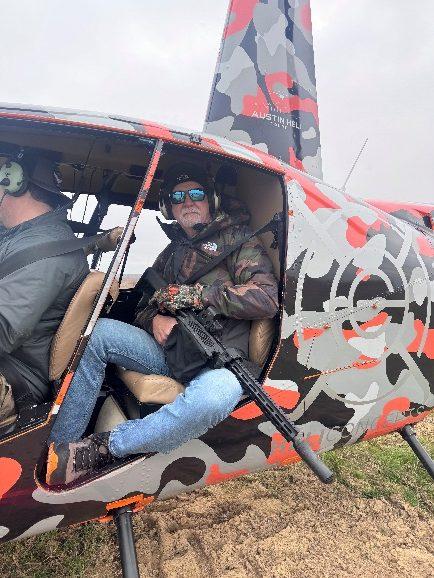
We lifted off smoothly and began our reconnaissance at something like 250 feet altitude. Within just a couple of minutes, we found our first sounder of about 30 pigs that took off running as soon as we approached overhead. Luke matched the speed of the helicopter with that of the pigs as Jeff and I commenced firing for effect. We took down at least a dozen pigs in a minute, then Luke made a run that resulted in our making a looping 180 so we could re-encounter our diminished sounder to finish any wounded pigs and take out a few more squirters.
Another five minutes and we were miles away from our first encounter. We then came upon another sounder, this time probably 20 pigs. Already schooled in Luke's process, we took half of the sounder on the first pass, then cleaned up any wounded during the looping return.
We were shooting 16" barreled AR-15's in 5.56 mm NATO chambering. While I'm not sure what brand ammo we were using, I can tell you that it was of the 55 grain FMJ variety. This is not at all what I use when we pig hunt at night with thermal scopes. Those occasions call for either 6.5 Grendel with 123 grain Hornady ammo or, more recently, subsonic .338 ARC Hornady 307 grain subsonic ammo. Both are very hard-hitting and very accurate in my AR-platform thermal-equipped rifles. Also, both are suppressed. So, this was a very different experience. I believe that we had more wounded pigs than we would normally have in our ground-based hunting because of two things: 1) the 55-grain bullet is very light for pigs, and 2) accuracy and shot placement precision suffers greatly due to the motion and speed of the helicopter.
Feral Pigs in Texas: Facts and Figures
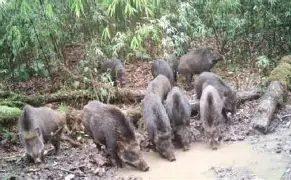
A word about feral pigs in Texas and hunting from helicopters. My last piece of information from the Texas Department of Parks and Wildlife was that there are THREE MILLION feral pigs in Texas. They constitute 50 percent of the total U.S. feral pig population. They cause somewhere between $500 and $870 million dollars in crops and livestock damage annually. And they are reproducing faster than they can be killed. Female feral hogs can begin reproducing as early as 6 to 12 months old. Gestation only takes 115 days, and each litter contains 4 to 6 piglets on average. This means that a female can produce 12-18 piglets annually. To maintain, not decrease, the current population requires that 40-60 percent of the total population be killed annually. While there is no specific reporting on the number of pigs killed in Texas annually, it is estimated to be a few hundred thousand at most, significantly below the threshold required to reduce the population and associated economic damage caused by this species.
Round 2
Following tracking and shooting a third and fourth sounder, we returned to our starting point where we dropped Jeff off and picked up our third hunting party member, Freddy, also and avid pig hunter and Dallas/Houston area businessman. I stayed on board as I was the organizer, host, and funder of this event. Off we went to a variety of new areas, where we continued to discover more pigs and reduced the populations encountered. Each repetition probably let us reduce the populations encountered by 25-33 percent before the remaining pigs escaped into cover that protected them from further assault from above. Thirty plus minutes of this and hundreds of rounds of ammo downrange and we came to the end of our event.
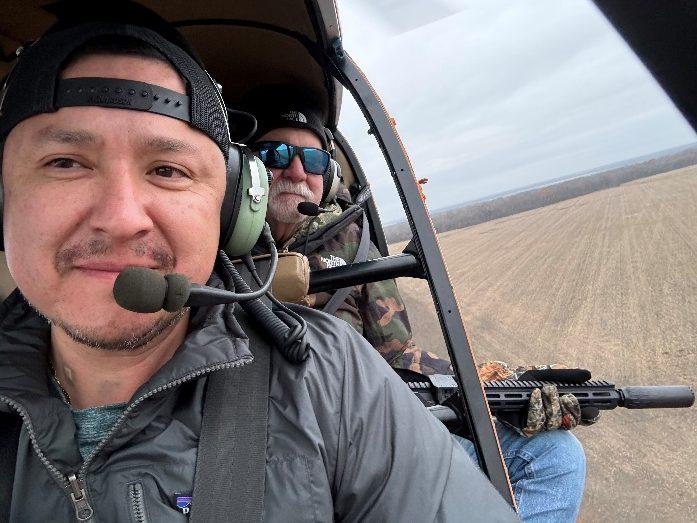
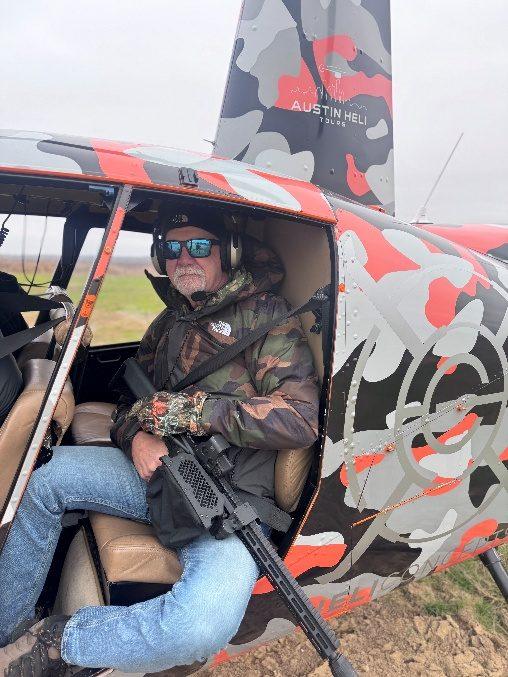
We returned to our point of origin, thanked Luke and Gabe, piled into our car and headed home. Our conversation during the drive centered on how utterly fantastic the whole helicopter pig hunting experience was. I was especially impressed with Luke's piloting skills as well as the performance of the Robinson R44 helicopter in his capable hands.
We will do another one of these events, likely with the same outfitter and pilot if possible. On a scale of 1 to 10, this was without a doubt 100.