Anyone who has ever read about African big-game hunting in the later 1800's through maybe the 1950's has been exposed to the mystique of the double rifle. Capable of launching heavy projectiles of 400 to 500 grains with exotic names like Rigby, Jeffries, and Nitro Express, these light, fast-handling, massively recoiling guns were used to take lions, leopards, rhinos, hippos, elephants, and Cape buffalos at very close ranges, often under 50 yards. On occasion, under the incredible pressure of a charging animal that could readily kill a person, a hunter on safari would miss his first shot and have no time to shoot again. Some stories like these had happy endings because a PH (professional hunter) killed the charger in time to save the client. Other stories had other, not so happy, endings where the hunter was maimed or killed before the animal could be dispatched.
That's the kind of background and context that was brought to mind the day I discovered what became my one and only double rifle. The place was the gun room at the Dorchester Shooting Preserve in Midway, Georgia (http://huntdsp.com). I was there at the invitation of my friend, Dwight, and his brother JB, both of whom are members. Our agenda was quail hunting and, if we were lucky, we might encounter some ring-necked pheasants. You can read about hunting at Dorchester here.
Back to the gun room. Although Dorchester is a bird-hunting operation, the owner is an avid hunter whose interests include big game. Many of Dorchester's members are similarly oriented. Accordingly, Dorchester stocks numerous brands and sizes of shotguns and an assortment of interesting rifles. It was while I was browsing through the inventory of the gun room that I encountered a F.A.I.R. double rifle chambered the 9.3 X 74R cartridge.
The Cartridge
The 9.3×74R (also known as 9.3×74R Rimmed) is a bottlenecked, rimmed rifle cartridge developed in Germany shortly after 1900 as an improved successor to the older 9.3×72R. It was designed to offer greater case capacity and higher velocities than its predecessor, making it more powerful for hunting and military use. The 9.3×74R remains a niche but respected cartridge among hunters and collectors, valued for its historical roots, rimmed design for easy priming, and proven performance. It is not widely available in the U.S. but can be found through specialty ammunition suppliers and handloaders.
The 9.3×74R uses a .366-inch (9.3 mm) diameter bullet, usually weighing 286-grains. According to Hornady, muzzle velocity is 2,362 feet per second muzzle energy is 3,536-foot pounds. It is used for hunting medium to large game animals and is very popular in Europe for wild boar. It remains a popular cartridge for African safari hunting in countries with more German influence like Namibia, favored as a continental alternative to the more popular .375 H&H magnum. Outside Europe, Ruger formerly produced its Number 1 falling-block rifle in this cartridge but has discontinued production of any rifles in this caliber. It has been a popular chambering in double rifles.
FAIR Firearms

FAIR primarily makes shotguns in classic Italian style. Located in the most famous gun-making region in the world, the Val Trompia, the firm also makes luxury rifles.
My Double
While I was enthralled with numerous beautiful shotguns in the gun room, I happened to notice what I initially thought was a .410 shotgun. I thought it was very short barreled for a shotgun, perhaps intended as a youth model. On closer examination, it turned out to be this odd (at least in the U.S.) caliber. That caught my attention. I used my phone and the internet to find out about this cartridge and thought this could be my chance to have my own double rifle. Then I looked at the price tag and almost choked. I was saved from making an impulsive decision by Dwight and JB who said it was time to get going on our hunt. Which is exactly what we did.
During our three-hour hunt, complete with pointers and a little flushing Cocker Spaniel named Lucy, and in between flushing and shooting dozens of quail, my mind wandered back to that damned double rifle. So, shockingly, when we finished our hunting, we returned to the Lodge for lunch before going home, and I took one more look at the double rifle in the gun room. From a purely economic point of view, it would be a dumb decision to spend thousands of dollars on a gun like this. But when are hunters and shooters rational people when it comes to guns and their acquisition? So, Captain Dave, as he's known (Dorchester Manager), happily put my new gun in its box and I took it home.
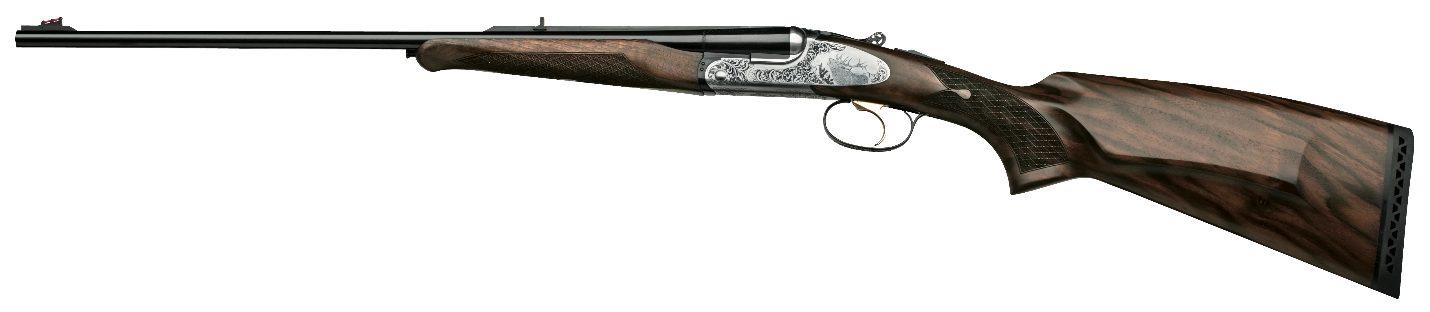
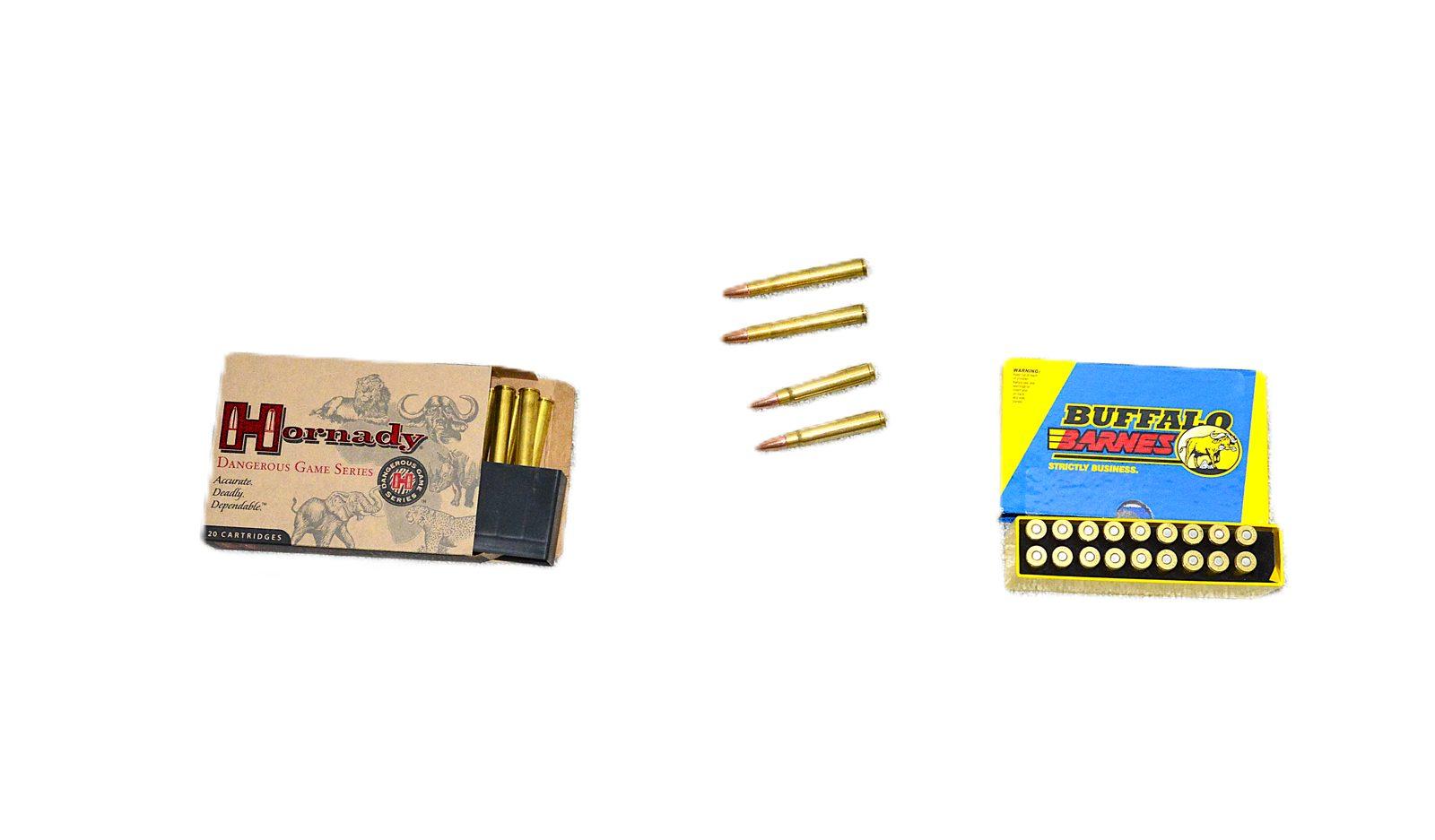
My double weighs 6.4 pounds, empty. Recoil is close to 40-foot pounds which, to say the least, is daunting. This is with 286 grain Hornady DGS ammo. My recommendation is to never shoot such a light gun with such a heavy recoiling round without a recoil pad. Pay attention!
The test target that FAIR furnished with my double shows a less than 1-1/2" group of two shots, one from each barrel, demonstrating that FAIR's hand-regulation of the barrels was effective. This rifle, while capable of longer shots than 50 yards, is expressly designed for close-quarters shooting. Just keep in mind, whatever you're shooting at, you've got two shots. The idea that you can quickly unload and reload is quite unrealistically. Can it be done? Can it be done under pressure? My recommendation is to make the first shot count—as is the motto at the FTW Ranch where I've done some precision rifle training, "Because you only have ONE first shot!"
This is absolutely not a gun you shoot from a bench while hunkering down over your gun. It is intended—no, it is REQUIRED—to be shot offhand. It can certainly be shot off of shooting sticks of some kind but it is truly intended to be shot offhand. I was able to put two shots into a 2-1/2 inch circle twice. At that point, I thought I'd had enough of this explosive device for the day. So, twenty bucks worth of ammo and with my bell rung thoroughly, I called it a day.
I have not yet, after two years, taken this monster gun hunting as I don't know what I'd hunt with it. In Texas, we generally hunt pigs at night with thermal scopes and, after years of that type of hunting, I've yet to take or make a shot under 100 yards. So, for now this beautiful blast from the past memory provoker does its duty on its own hangers on one of my gun room walls. Perhaps one day, I'll put it to real work. Probably not real soon.
Current pricing on the Hornady 286-grain DGS ammo is about $5 per round, much cheaper than the $10 per round for my .416 Rigby. Nevertheless, it's big bucks and a beating for every shot taken.