When Federal introduced the 7mm Backcountry cartridge and touted it as the next big thing, I was, like many other people, immediately skeptical. After all, how many next big thing cartridges have been introduced in the last few years? To name a few, the entire PRC line—.22, 6.5, 7mm, and 338, for example. Then there are the many Creedmoors, the .224 Valkyrie, the various Weatherby RPM's, the many Noslers—the 22, 24, 26, and 28. How about the .277 Fury? Just a lot of stuff. After the vaunted 7mm PRC, which was hailed by its fans to be the perfect 7mm cartridge, was there really room for yet another wannabe? My skepticism turned to curiosity and then to intense interest when I learned that this wasn't another 7mm cartridge. It was instead and entirely new shooting technology whose repercussions are just now beginning to be felt. I'll explain.
The 7mm Backcountry cartridge (https://www.federalpremium.com/backcountry) is built on what federal refers to as PEAK technology, essentially a proprietary steel case that mimics the superstrength steel used in nuclear reactor containment vessels—these are steel encasements that contain a massive explosion that can potentially result from a nuclear reactor meltdown. Essentially, this case permits pressures resulting from burning powder to safely reach pressures of at least 80,000 pounds per square inch as compared to, for example, the 7mm PRC and the 7mm Remington Magnum that operate at maximum pressures of 65,000 psi as specified by SAAMI—Sporting Arms and Ammunition Manufacturers' Institute—(https://saami.org). Equally as important, the high pressure 7mm Backcountry is perfectly safe for use with current modern rifle actions, barrels and chambers. As a hunter and shooter, imagine being able to shoot a 170-grain bullet at 3,000 feet per second muzzle velocity from a 20-inch barrel! To do the same with the 7mm PRC, you need a 26-inch barrel (https://tscustomsrifles.com/7mm-prc-barrel-length-vs-velocity) On the other hand, add a Titrex suppressor (https://precisionarmament.com) that weighs about 9 ounces and is a short 6 inches and you have a fantastic very powerful hunting rifle. If you added that same suppressor to a 26-inch barrel, you'd have a very unwieldy rifle unless you are solely a stationary bench or tripod shooter.
Now, with that background as context, let's look at the rifle in question. Built at my request by Lloyd Hill of Genesis Rifles (https://genesisrifles.com), we started with a Zermatt Origin action, added a new technology threaded Proof Research PXT carbon fiber barrel measuring 16.5 inches, Trigger Tech Diamond trigger, an MDT 26 chassis with folding/locking stock, and topped off by a Kahles 5-25i x 56 scope contained in Tally rings.
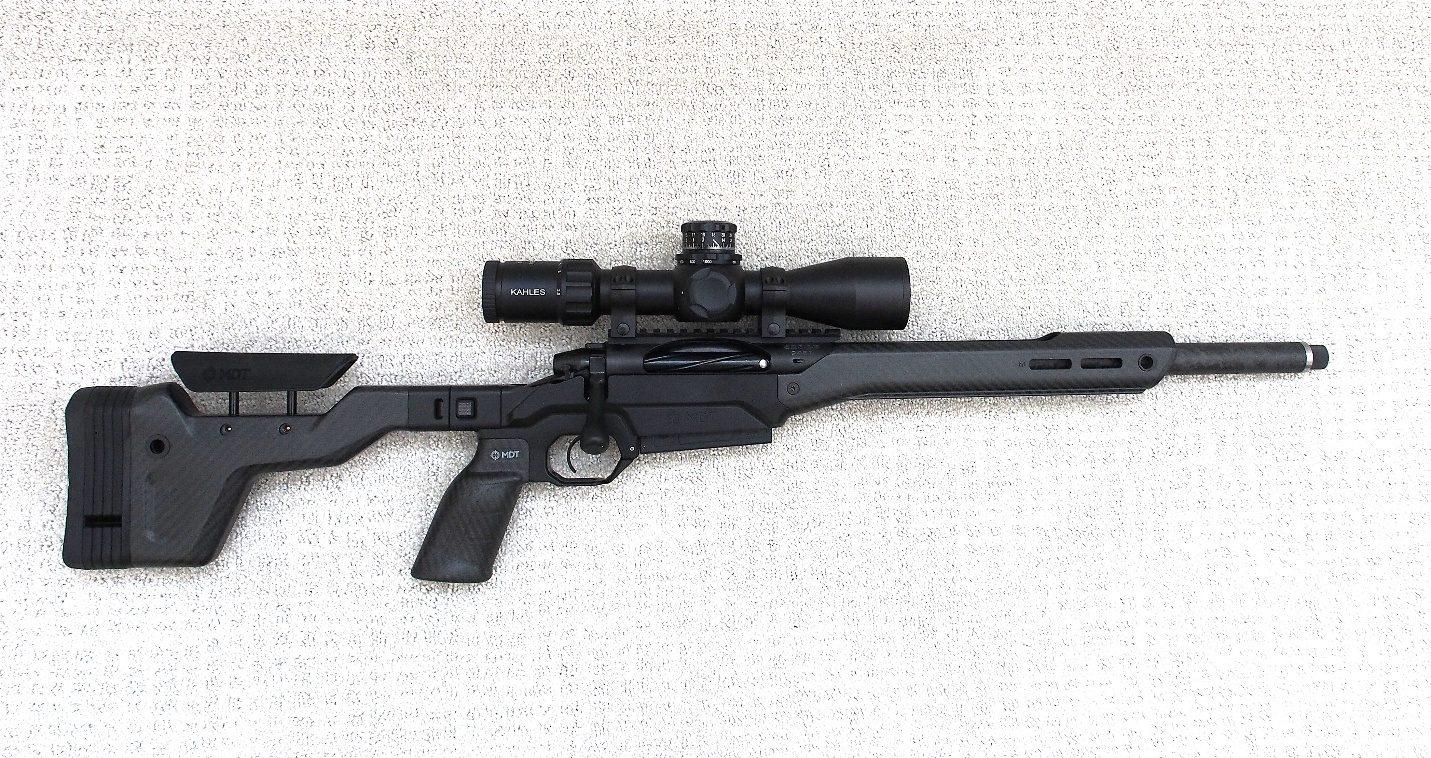
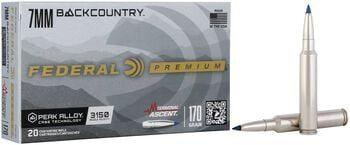
This entire compact rig weighs in at 8.8 pounds which, amazingly, is heavier than my .375 H&H Magnum! The Kahles is a fairly heavy scope and the chassis has the optional ARCA rail that adds a few ounces. When you add my Titrex 30 suppressor, the overall barrel length is 22.5 inches and the gun weighs just under 9 pounds empty. Unsuppressed, this rifle has what I think is fairly mild recoil, just over 20 pounds—more or less like an unsuppressed off the shelf type .30-06. Cut that recoil energy in half with the Titrex suppressor and this is a genuinely fun gun to shoot, repeatedly. Cost-wise, a box of 20 runs anywhere from $45 to $65 per box, meaning about two to three bucks per round, depending on what bullet is in your selected loading. Bullets options include 155 and 170 Terminal Ascent, the 175 Fusion, a 168 Barnes LRX, and the incredible 195 Berger. The latter is easily shootable to a mile from this little gun.
Speaking of shooting, Lloyd and I got the chassis and barreled action assembled and properly torqued. An important note—Lloyd uses special gasket material when mounting a barreled action to an MDT chassis. By doing so, the rifle is inherently more accurate than without it. I can't explain it. Lloyd has some voodoo explanation but this, among other things, is why he continually builds, tests, and proves the most accurate, repeatable precision rifles in the world. We mounted the scope properly—I tell you, Lloyd is the most meticulous gun guy ever—ensuring that the Tally rings were perfectly torqued, the scope absolutely plumb, and eye relief just so. At that point it was zero time. We intended to shoot off a bench using a Huskemaw bench tripod (https://huskemawoptics.com/collections/accessories/products/huskemaw-bench-tripod). Lloyd bore sighted and, as is his custom, wanted to zero at 100 yards precisely. Three shots while I manned the spotting scope. Point of aim was the bottom point of a 1-inch square. A .1 mil elevation adjustment was made as the windage was perfect. Garmin Xero 2 showed 2944 fps. Lloyd moved to the next untouched square and called bottom left corner of the square which is exactly where the bullet impacted. Second shot was halfway in the same hole as, looking through the spotting scope, I could see the initial hole slightly expand as the second shot cut just a little bit away. While we were talking about what a great shooter Lloyd is, he let the barrel cool for a minute, saying that so far, he liked what he was seeing. The Garmin, by the way, registered 2940 fps—I should note that we were shooting the Federal 170 grain Terminal Ascent round. Shot number 3 entered the same hole as the other two previous shots! Unbelievable! But true. Now it was my turn. Again, we let the barrel cool for a minute, although it was only nominally warm to the touch. I did check the direct thread mount Titrex to make sure it was securely fastened as direct thread mounts have been known to "walk" themselves loose between shots as the barrel repeatedly heats and cools. I confirmed with Lloyd, who was now manning the spotting scope, that I would aim at the bottom left corner of the next clean 1-inch square on our zeroing target. Looking through the Kahles, I set the magnification at 10X and found my aimpoint and gently touched off my round between breaths and heartbeats—at least I believe I did because the hole that appeared on the target was precisely where I'd aimed. Wow! Ran the bolt, clean ejection. So far, happy day. We let a minute pass and I hand fed the next round into the chamber. Again, checked my setup and breathing, had absolutely a clear view of my aimpoint, which was literally the hole in the target, and again, timing my trigger work, sent round two downrange as Lloyd was exclaiming, "Dude, that was in the same hole!" Now, I think I'm a pretty good shooter as I work on everything that great shooters have taught me as often as I can but this was a) surprising, and b) super cool! I did remember to run the action, clear the chamber, and take another minute before I hand fed my third and final round. Lloyd encouraged me to run my routine and to not get too anxious or uptight. As he focused in on the spotting scope, he said, "Send it." So, I did. Hoping for a miracle I said that I'd made a clean shot, good trigger, good sight work. He said that it paid off as round three was touching the initial hole. We had both shot 3-shot groups, back-to-back, that nominally measured about .426 inches edge to edge, which, to put in perspective, is 1-1/2 bullet diameters. The center-to-center measurement is .142" which is just over one-tenth minute of angle (MOA). The Garmin showed our six shots averaged 2942 fps with a 6-fps standard deviation. This is simply incredible ammo and its performance is the best I've ever achieved with any rifle.
We needed a break before proceeding to next steps so we raved to each other about this gun and round—Lloyd is a devoted 28 Nosler guy but he said he was maybe possibly going to reconsider the 7mm Backcountry. We shall see.
I did my environment capture with my Kestrel 5700 Elite WEZ. A beautiful sunny day at our Ennis, Texas range. Temperature was in the upper 80's and there was a negligible wind. I ran my data and produced a range card. Our targets are at known distances (at least known to us as we range them constantly depending on position at the shooting line). We began at 200 on hanging steel 2 x 2-foot targets, each of which has a 1-inch orange painted circle in the center. To say that center punching targets to 500 was easy is an understatement. We moved from 200 to 500 in 4 shots, each one reflecting great elevation data from the Kestrel. At 600, there may have been a little wind as my shot was on elevation but just missing the right side of the orange circle. I made a .1 mil left windage adjustment in the reticle and shot again. Center cut. 700 and 800 were just outside right and just low of the circle—which, frankly, is incredible performance from this stubby rifle on its first day of life.
900 same thing but after two more rounds and hold/elevation adjustment of .1 mil more than calculated in the Kestrel, the orange circle was mine. Finally, 1000 yards took three shots to clean the circle and we called it good for the day.
I did not have the time to do more that day but went back out a couple of weeks later—much hotter and windier but the first shot—cold bore—to 1000 verified my DOPE despite the environmental conditions. I learned my best lessons about windage at the FTW ranch, a story told separately from this but worth telling which I've done in another section of this website. Look for it, it's worthwhile. As was the initial zeroing and shooting to 1000 yards, I used the 170-grain Federal Terminal Ascent ammunition.
I did not plan to shoot intermediate distances between 1000 and 1780 which is our 4-foot by 4-foot steel AR 500 target that is so big and heavy that it is held up by steel supports but the bottom rests on the ground. We keep the grass trimmed so as to not obstruct any portion of the target. Believe it or not, we use 2-inch orange painted circles as aimpoints but frankly, even at 25X magnification, I can't make them out. I just know where they are in relation to the center of the target so I basically aim for the center of the target horizontally and the middle of the left or right half of the target vertically. I hope that makes sense to create a visual image in the mind. Trusting my Kestrel DOPE, with adjustments to the predicted elevation hold and doing my best to estimate a quartering left to right wind at what I thought to be 7-8 miles per hour, I shot off the bench using an Armageddon bag and a little hand bag to manage my hold, then fired for effect. Elevation was .1 mil low and I held .3 mil left which turned out not to be enough so I was at least another tenth mil right on the target. But a first shot hit at a mile! Two more shots and I had my elevation perfected but the windage remained variable and I never burned the center orange dot. I drove an ATV out to the target to measure things just for the fun of it and discovered that the last three shots I made were inside a 6" circle. From a 16.5-inch barrel! Seriously, that's just crazy.
So, to end this rambling, let me just say that the Federal PEAK technology is just getting going and I'm a raving fanboy. You can have all the debate you want about how it doesn't do anything the 7 PRC or 7mm Remington Magnum does. You're only fooling yourself. Just wait, there's so much more coming. Just announced in the last month, the Federal 6.5 Creedmoor +PEAK will turn your 6.5 Creedmoor into a 6.5 PRC velocity and performance-wise. I predict you'll soon see Federal .308 +PEAK that will perform like a .30-06 or better and there will be a .30-06 +PEAK that will essentially perform like a .300 Winchester Magnum. Even if you're not a gun nut or nerd, you'll still have to be amazed at how significant PEAK technology is.
Stay tuned. There's much more to come.