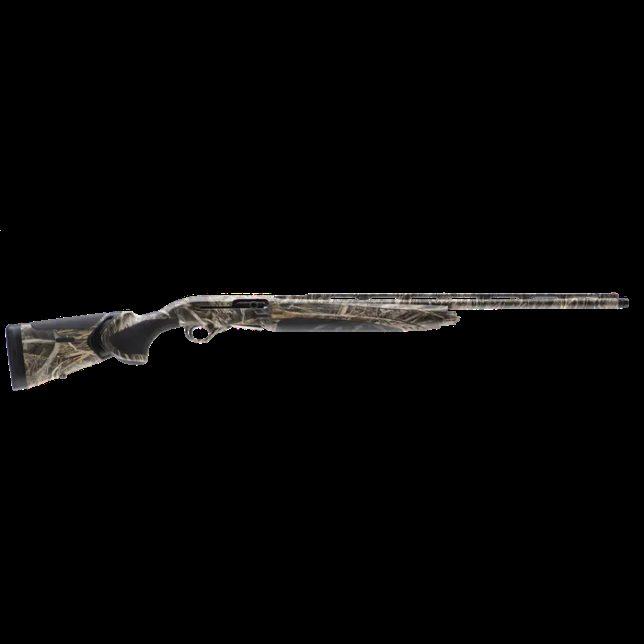
"What are you doing in September," my friend Dwight asked me sometime right after the beginning of the new year. "Nothing I know of," I replied. Dwight then proceeded to tell me I was going to Saskatchewan with him, JB along with one of his friends, and Art to participate in the best duck and goose hunting in the world—Dwight does nothing that isn't the best in the world. So, it went on the calendar. This hunt would require 12-gauge only, 3-inch steel shot, and a lot of shooting so that ruled out my Beretta 686. Instead, a year or two earlier, I had purchased a Beretta A400 Xtreme Plus with the KO (recoil reducer) option. With a 28-inch barrel, it is fantastic as an all-around duck and goose gun as well as being great for sporting clays. It can be shot all day long with no damage to the shoulder—I cannot say the same for my 686 over/under.
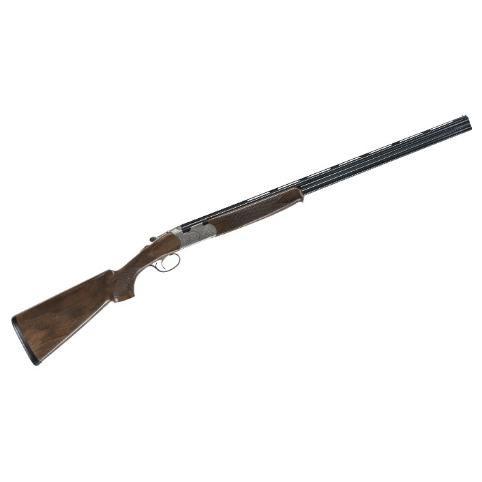
I had an opportunity to participate in two sporting clays "tournaments" which were charity fund-raisers prior to departing for the Canada adventure. I needed the practice as I otherwise wouldn't have had any opportunity to brush up on shooting skills with the big 12-gauge. Generally, I get to occasionally hunt quail and maybe pheasant a couple times per year and, for that, I am absolutely enamored of my Beretta 686 28-gauge which is fast, easy, light, and fits me like a glove.
Anyway, here's the rest of the story. As I live in Dallas, I had to fly to Hilton Head Island, South Carolina where I used to live. I was to stay at my friend Dwight's house the afternoon/evening before departure as we would be leaving the island airport at 7:00 a.m. next morning on his Cessna Citation Encore with JB and his friend Kenny, to pick up Art in Rockhill, North Carolina.
So, we did all that and headed west to make a refueling stop somewhere in Kansas. The flying weather was perfect and we were all talking about hunting and good memories of this and that event. Some possible tall tales may also have been told by one and all. Next stop after Kansas was Saskatoon, Saskatchewan, Canada where we cleared customs and immigration. We had our individual firearms inspected and confirmed as being those we declared on a Canadian form for the purpose of getting a permit to bring them into the country for purposes of our hunting trip. It was made clear to keep the approved form available for subsequent inspection on demand (which we did not experience) and in order to leave the country with the listed firearm when our hunting trip ended.
Despite it being a bit bureaucratic, all went smoothly and we reloaded all our gear back onto the plane to go further north—destination North Battleford, Saskatchewan located at 52 degrees north latitude, placing it approximately 1200 miles north of Dallas. It's about a third of the way to its northernmost boundary and on about the same latitude as Dublin, Ireland.
Saskatchewan is a huge province—it is twice the size of France or Spain to put its size in perspective. Ten percent of it is fresh water. There are only 1.3 million people living there so you can imagine that there are huge largely uninhabited land areas, much of which is given over to large scale farming. The combination of large, recently harvested fields in the fall along with massive lakes, rivers, and ponds results in huge numbers of ducks and geese of all kinds, all of whom feed and fatten up in preparation for the southward migration that the initial signs of winter stimulate.
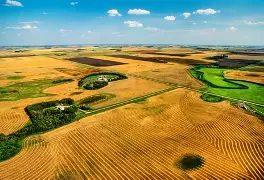
We arrived in North Battleford and checked into our hotel. There aren't hunting lodges in the area and, amazingly, it turns out that there is no public hunting land. Each outfitter engaged in hunting must get the specific permission to hunt from the landowner where hunting is conducted. Obviously, this means that good outfitters must have many, many effective and positive relationships with local farmers and landowners in order to offer guided hunts. We were signed up with Prairie's Edge Outfitting (https://prairiesedgeoutfitting.com) a well-known and highly regarded professional organization that enjoys exceptional relationships with local landowners. As a result, they are able to offer the best locations for duck and goose hunting available in the area. We went to a local restaurant adjacent to the hotel for dinner and returned to the hotel, each of us getting organized for a 4:30 wake-up and meeting our guide for the day at somewhere around 5:15 a.m.
Day 1—Morning
We met, got introduced and piled our gear into the truck and attached trailer that took us out to the site of the morning hunting event. It was a little over 40 degrees and very dark.
The hunting plan was as follows: first, each of us, including the guide was to gather up local brush that was growing in the areas adjacent to the recently harvested open field where we'd be setting up. We would use this brush to develop camouflage for the layout blinds we'd be concealing ourselves in. Each person had his own layout blind. Essentially, a layout blind is a coffin like enclosure made of canvas and having a pillow for a headrest as to use it, you must be lying down with your shotgun loaded, on safe, and ready to be deployed when the guide says, "SHOOT!" At that command, you pop-up and, in so doing, the flaps of the blind open and you sit up, quickly mount your shotgun and fire away.
Before any of the shooting starts, though, everyone must participate in laying out the decoy field. The aforementioned trailer attached to the truck in which we were transported from the hotel, is filled with around 250 duck and goose decoys on stands. This, on one hand, makes it easier for each person to carry a lot of decoys, and, on the other hand, allows the decoys to swing with changes in wind direction. There were several motorized decoys that flap their wings as part of the decoy field. As noted, the open field area was recently harvested and there were a lot of residual pulses left throughout the field, upon which the ducks and geese can readily feed themselves without much effort (a pulse is the dried edible seed of a legume plant, which includes beans, lentils, chickpeas, and peas, all of which are grown in Saskatchewan). Once the decoy field was set and the layout blinds camouflaged, our guide moved the truck and trailer far enough away that it would not be a distraction to the ducks and geese. The five of us hunters climbed into our individual blinds and awaited sunrise—all of the setup was done in the dark. It should be noted that headlamps are an essential piece of gear to have for this early morning workout.
As light broke, it didn't take long before the first flight of probably 40 or 50 huge snow geese flew in above our decoys like a flight of B-52's! These were very large birds which, when about 30 to 60 yards out, our guide gave the SHOOT! command. Everyone popped up and the blinds were open. Shotguns brought to shoulder and a number of big bright white geese were taken.
There is honestly nothing like the numbers and flights of geese that we experienced that morning. Ducks were part of the action but nowhere near as numerous as the geese that morning.
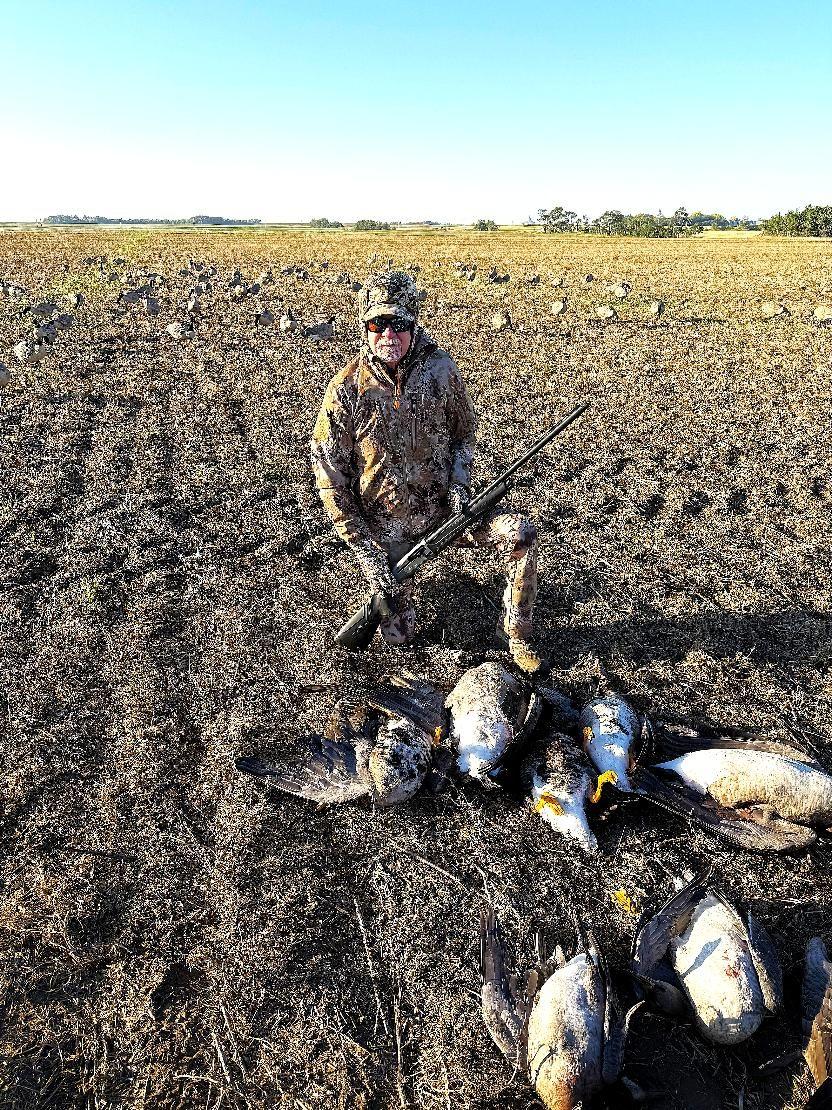
We kept up with the shooting and reloading repetitions until about 10:00 a.m. when we dismantled the decoy field and the decoys into the trailer. We followed that up by breaking down the layout blinds and loading them up. Finally, we retrieved all of the ducks and geese and loaded them in the back of the truck along with guns and gear. Exhilarated and wide awake from the adrenaline rush that had gone on for hours, we headed back to North Battleford for a well-deserved big breakfast. The day was crystal clear with pristine blue skies, utterly clean air, and now the temperature was in the mid-fifties.
Day 1—Afternoon
After breakfast, we took a break (and a nap) until about 1:30 p.m. at which time we met our guide for the afternoon hunt. Loaded our gear and guns and headed to a new venue. We arrived at a very recently harvested field that was littered with some kind of white peas that would be a feeding attraction for ducks and geese who were gathered in big numbers in a nearby large pond. We could hear them honking and calling and we quickly set to work again building out our layout blinds and setting the decoy field.
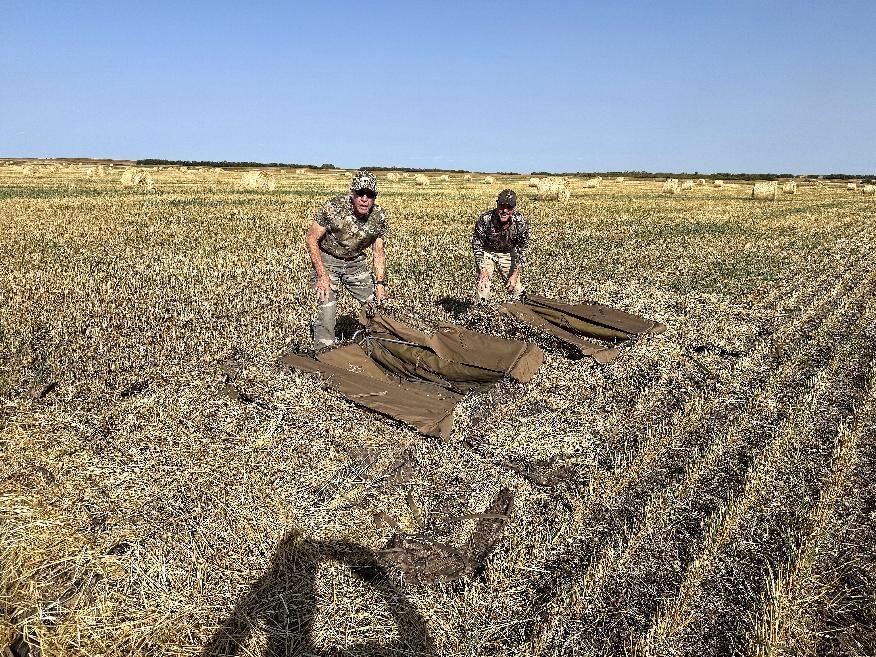
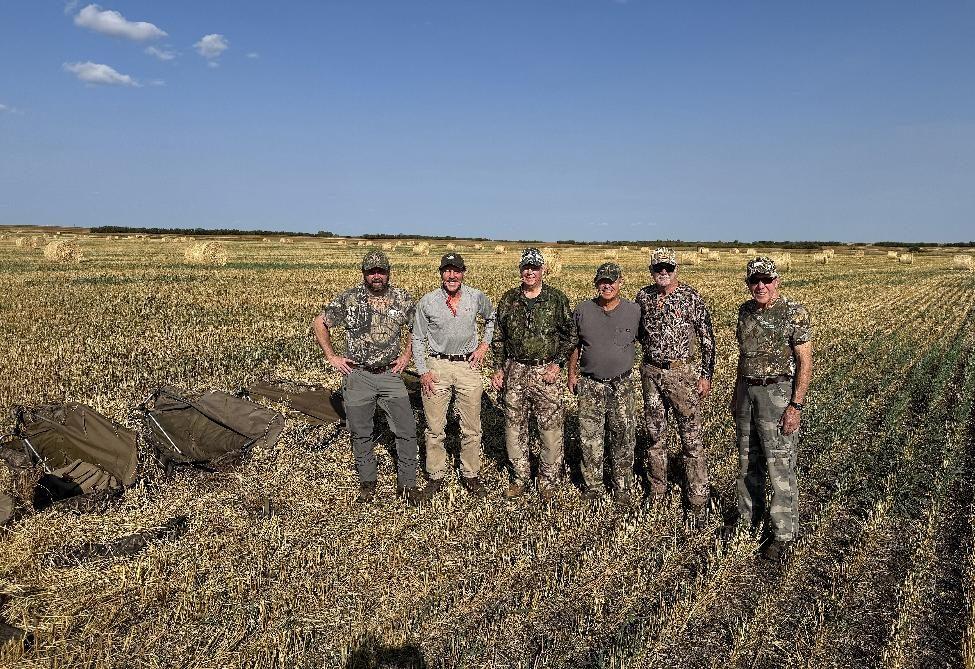
The temperature had risen to the mid-fifties and, with the sun out and a clear sky, we were very comfortable lying in our layout blinds awaiting the first ducks and geese to fly in. Our guide used a call to invite the birds and, sure enough, they showed up in huge numbers. On the command to SHOOT! we all popped up and fired. Utter silence and no movement moments before were now followed by mayhem and probably forty or fifty rounds expended in a matter of less than a minute. We successfully shot at least a dozen geese of several varieties—Canada, Snow, and Speckle Belly—as well as two or three ducks. From my perspective, while I love duck hunting, there is nothing quite like being in the midst of a flock of huge geese with your favorite shotgun. To say that the experience is amazing just doesn't do it justice.
As the first geese cleared our setup area, we excitedly prattled with each other about how fantastic that first round was. Then, we settled back into our blinds, quieted down, and went on standby as our guide worked his call again. In just a few minutes, another flight of what 15 geese was probably flew toward our decoy field, we were told to shoot, and I cannot forget the sight of at least a half dozen geese cupping and preparing to land 20 to 25 yards in front of me. I scored a double and by the time I swung onto what were now rapidly departing geese, I held fire as these speedy birds were now long gone.
This process was repeated multiple times during the afternoon and we called it a day by 5:30 p.m. when we broke down our blinds, collected the decoys, gathered our harvested ducks and geese, put guns and gear in the truck, and loaded up to go back to the hotel. When we arrived, we took our guns and gear back to our rooms, changed out of our hunting apparel, took showers, and gathered in JB's room for a cocktail before dinner. Dinner was at a local restaurant and was very good. There was no shortage of either food or drink and, not wanting to insult the restaurant manager and wait staff, we ate and drank everything that was available to us before thanking the service folks and returned to the hotel—fat and happy. Early to bed so we could arise yet again at 4:30 for a 5:30 departure next morning.
Day 2—Morning
Repeat Day 1 morning in a different venue. Again, a recently harvested vast field with a lake/very large pond adjacent to our hunting setup. Decoys and layout blinds. We were much more efficient this go-round than yesterday's first run. Once we all had the idea of how to set up the decoys and build out the camouflage for our layout blinds, it was a very rapid process. Once done, we retreated to our individual blinds, listened to our guide call geese and ducks, and responded very effectively when told to shoot. No matter how many times you do it, popping up from within the layout blind and instantly taking in the flights of birds zooming into the decoy field provides a huge rush of adrenaline. That, in turn, focuses your mind and vision allowing you to get two or three shots off in the seconds before the birds spot you and take off at speeds that are amazing. As was the case in the previous day's hunt, we took down our limit of geese as well as maybe a dozen ducks.
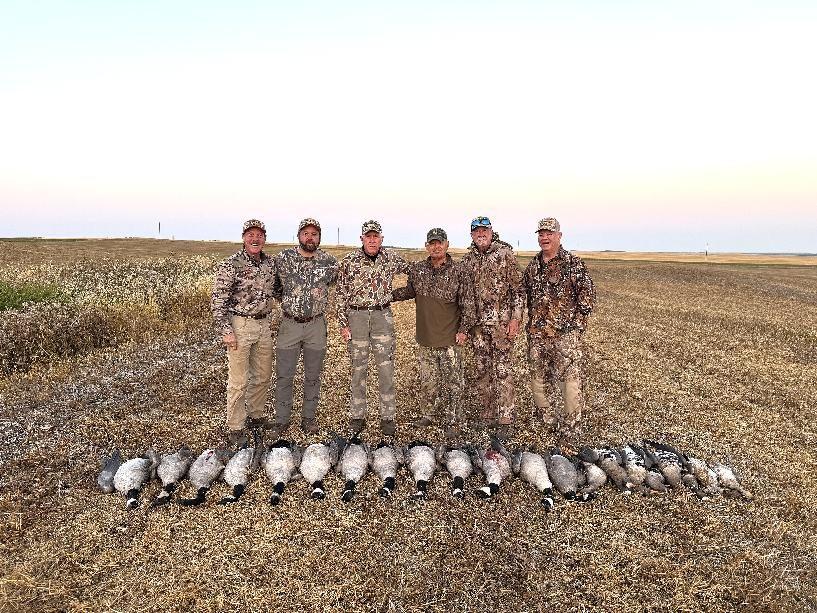
For those who may wonder what is done with all of the meat harvested, the answer is that we donated about 98 percent of what we shot to the local Cree Indian Reservation food program where it was happily received, creating a feasting opportunity for local residents.
As per the routine, collected decoys, broke down the layout blinds, gathered our ducks and geese, loaded birds, guns, gear, and hunters into the truck and back in time for breakfast!
We expected a replay of the pattern we were in—that is, meet our guide, head to a harvested field, set up blinds and decoys, and call in the birds for the explosive, fast action that we'd experienced thus far. Turns out, that wasn't the plan at all. Instead, we rode to a large pond that was surrounded by cattails that were probably 6 or seven feet tall. These surrounded the water and were at least 20 to 30 feet from the water's edge to where we entered them from the adjacent field. Our guide told us to walk half-way through the cattails, which gave way very easily. Once that was done, he had us lay some cattails down to make a bit of a mat on which to stand in a secure position. Interestingly, the cattails were not in water but afforded us natural blinds without us having to wear waders! Within a few minutes of getting situated, ducks by the dozens flew in front of us and we did our thing. Ducks, geese—the next two hours went by quickly with nearly constant action, each flight of ducks and geese was met with our proficient shooting and we limited on ducks quickly (limits are 8 ducks per person, 24 in possession). We bagged numerous geese of varying types, again limiting within the two hours we spent in the cattail blinds (limits on geese are a bit more complicated—8 dark geese such as Canada and Speckle Belly per person, 24 in possession and 20 light geese such as Snow and Ross's per person, 60 in possession). I found the cattail blind experience to be the best of all our hunting events in Saskatchewan. It was like the bird hunting I grew up with a hundred years ago—natural cover, no equipment to put together, no decoys—just me and my shotgun.
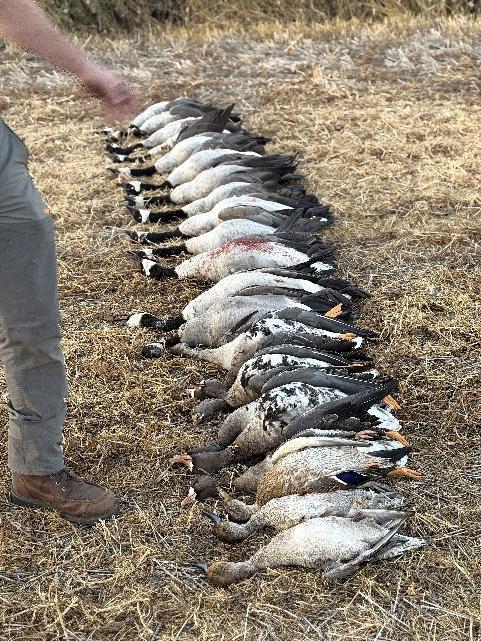
Once again, loaded everything, including our birds, and returned to the hotel for showers, change of clothes, gathering for cocktails and a review of the day's events, and general fellowship among hunting buddies. A lot of entertaining stories were told, especially by Kenny, a Louisianan from New Orleans (or Nawlins, as he calls it) with a genuine gift for storytelling.
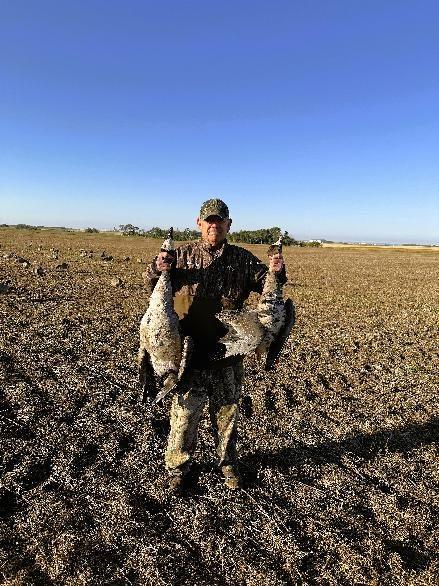
Another dinner with drinks all around. A little less energy than our first night out as we had expended a great deal of energy in the past 72 hours which included travel and the hunting events. I personally dislike waking up at 4:30 a.m. and getting going but the reward is so worth it that I don't whine and complain which would otherwise be my instinct. Bedtime was welcome and sleep came easy.
Day 3—Morning
Won't belabor the morning which was a repeat of the prior two mornings, from early rising to successful hunting from the layout blinds to breaking everything down that we set up in the dark to going back to town for breakfast and a break before our last afternoon hunt. Success came so easily in this environment that it was now expectation that everything was going to go swimmingly well. Not so fast!
Day 3—Afternoon
Loaded up and this time went to a harvested wheat field which had hundreds of huge rolled haybales on site. We pushed two of them together—they are super heavy but easily moved on flat land—and formed a backdrop for our layout blinds which we quickly set up. Then put the decoys in place with the result looking like a recently harvested field where lots of ducks and geese were feeding. We had on the way to our hunting venue, seen several similar fields that had actual ducks and geese feeding in abundance.
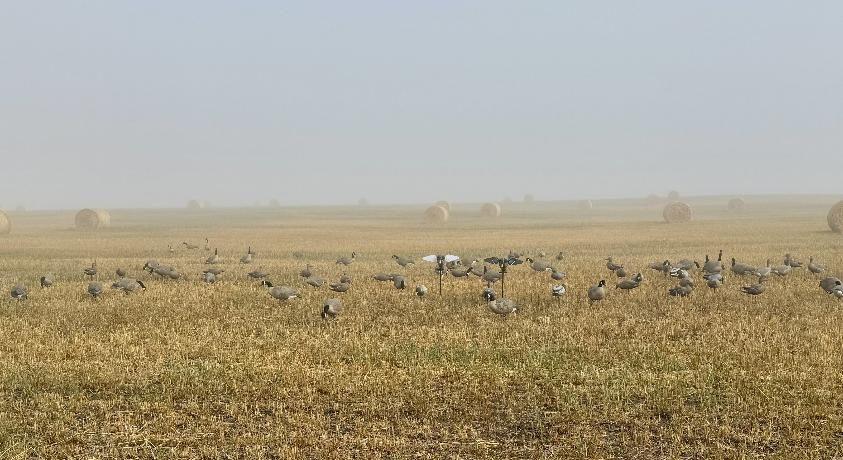
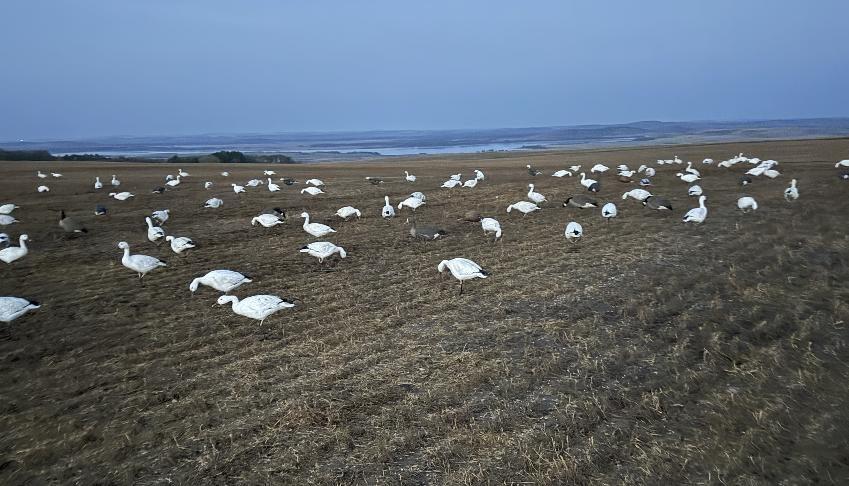
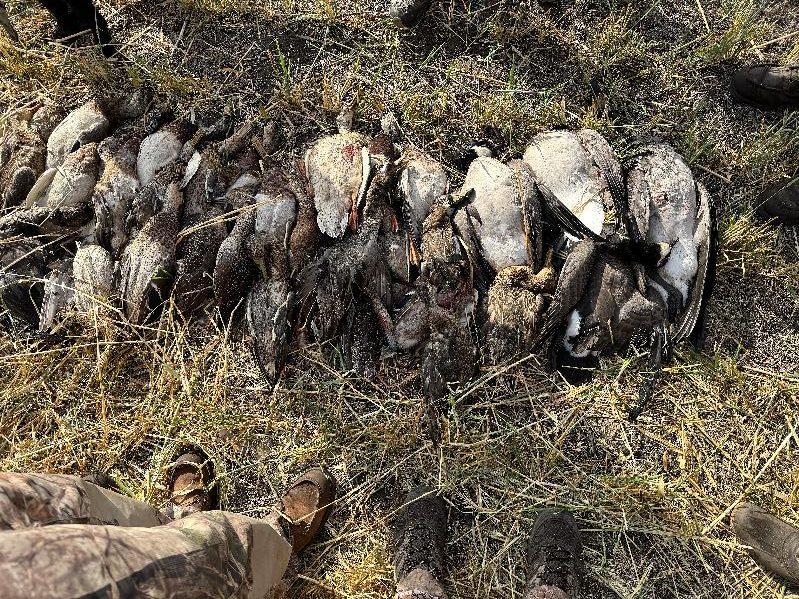
Our guide for our last hunt brought his retriever and we thought we'd give him a major workout. As it turned out, we had only a few ducks show up to our location and, I am happy to say, three of them were harvested by me. Our total haul for the afternoon was very low as can be seen in the photo below.
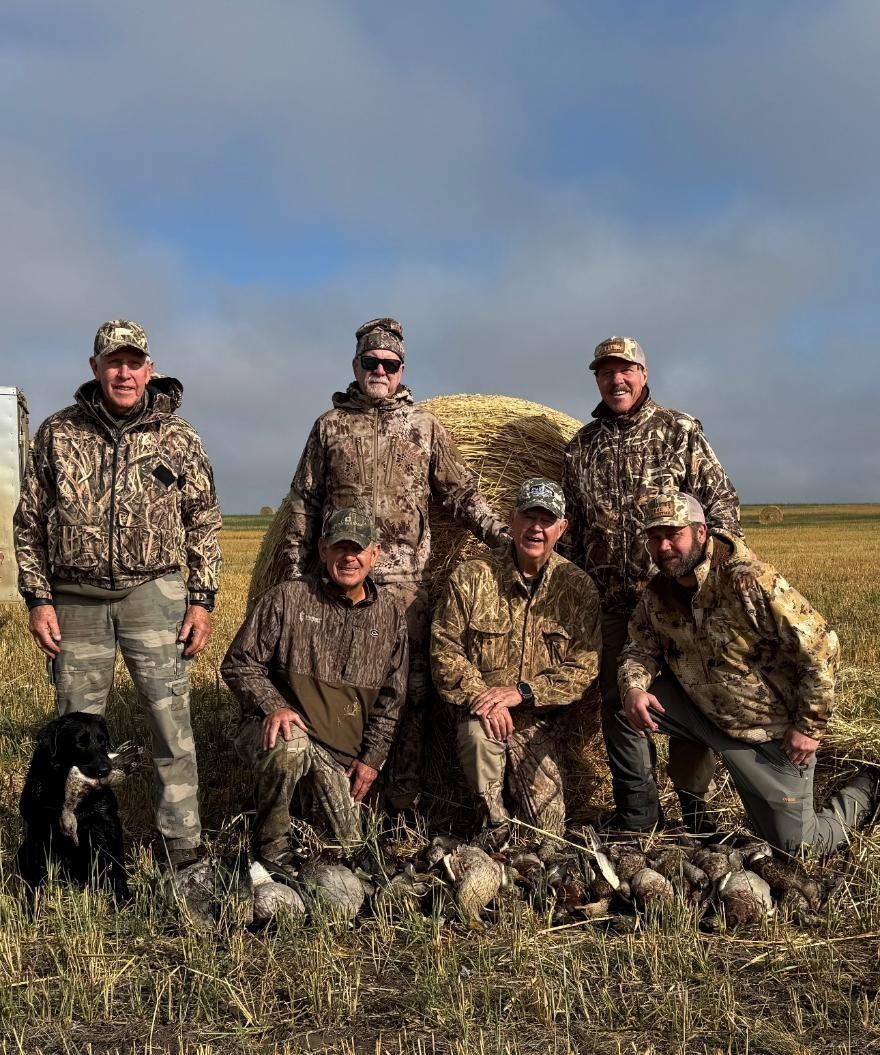
A small total but we were about to be rewarded with a magnificent end to the day!
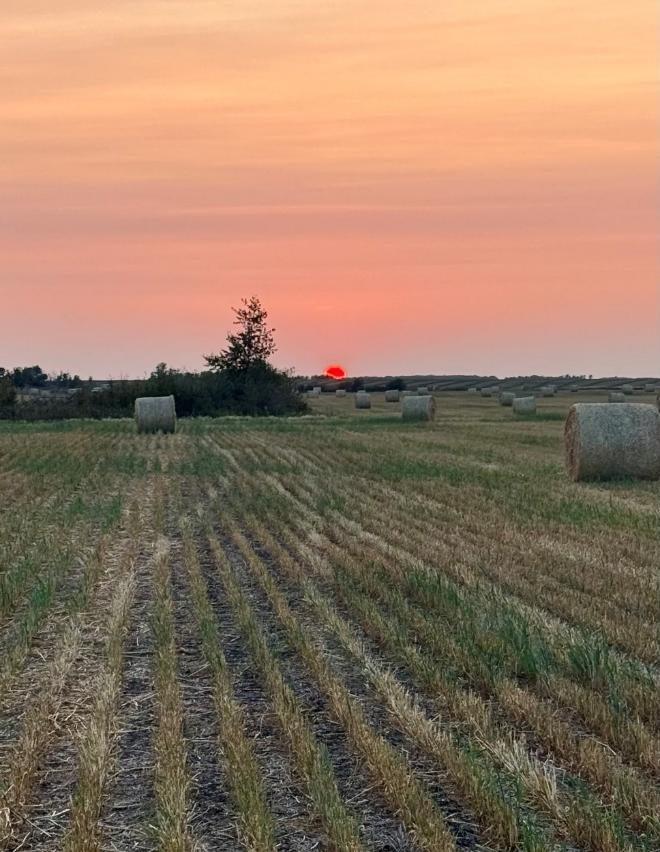
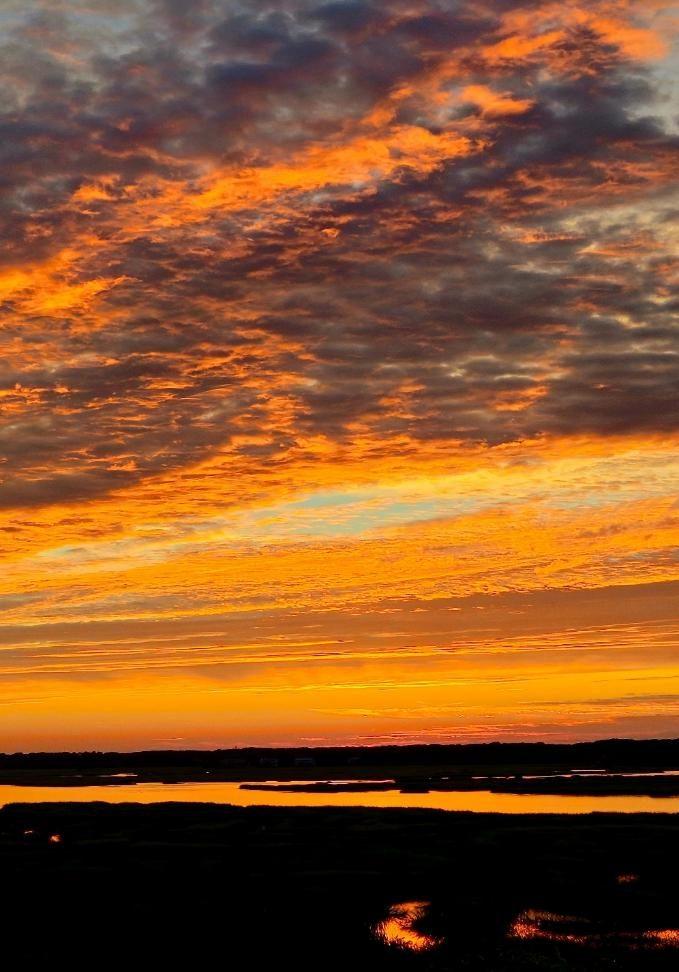
As we sat and watched the magnificent sunset, we were struck by the incredible beauty of God's creation. I think all of us prayed our thankfulness for the time and place we were in, our time together, and the incredible fellowship that we had enjoyed and reveled in for four days.
However, all good things come to an end as did this fantastic trip and experience. We went back to the hotel, cleaned up, had a final dinner which was great, returned to the hotel and called it a night early as we would be leaving first thing in the morning—first thing turned out to be 7:30 a.m. which meant sleeping in!
Back to the local airport, loaded ourselves and our gear into the plane and off we went to Saskatoon to clear the customs exit process and show that we were taking our permitted shotguns with us. Paperwork only—no big deal. Then off again to clear U.S. Customs in North Dakota where we did have to show our stamped Canadian documents to demonstrate that we were returning to the U.S. with the same guns we took into Canada with us. Refueled while there and then it was on to a very brief stop in Rockhill, North Carolina to drop Art off. The rest of us proceeded to Hilton Head and arrived at about 8:30 p.m. when we split up to go our various ways. I stayed overnight at Dwight's and left very early via Uber for a flight to Dallas from Savannah. Back home early to unpack, do laundry, and take my wife to lunch and dinner. She was very generous in letting me go on this bucket list trip with the boys.