I was born in an era where western movies, cowboys, and the new thing called television delivered countless programs about the old west—Gunsmoke, Bat Masterson, The Cisco Kid, Tombstone, The Rifleman, The Virginian, The Big Valley, Bonanza, The Lone Ranger, Roy Rogers, Have Gun Will Travel, Wagon Train, and so many more. Western movies were THE genre of my youth—High Noon, Shane, The Searchers, Treasure of the Sierra Madre, The Man Who Shot Liberty Valance, The Magnificent Seven, The Alamo, and Winchester '73 are for sure the "A" list.
Winchester lever guns played a key role in the TV and movie depictions of the Old West and in the reality of those times. As a kid, one Christmas long ago, I got a toy Winchester lever action rifle that gave me months of fun fighting off imaginary Comanches and Apaches as well as evil outlaws seeking to do me harm. It was from this context that my lifelong love affair with rifles in general and lever actions in particular was born. Over the so far seven plus decades of my life, I've acquired dozens of lever actions in just about every caliber offered—including .22, .30-30 (originally the .30 Winchester Center Fire or WCF), .35 Remington, .357 Magnum, .44 Magnum, .44-40, 444 Marlin, .45 Colt, and the big banger—.45-70 Government. I regret every one that I've sold, especially my fabulous Marlin Model 39A with octagonal barrel, and wish I had them back but there are 7 or 8 currently standing proudly in racks in my gun room.
There is one separately, however, that is on display, in my media room. It is a work of art that began its life long ago. Here is how the story goes. On August 9, 2016, I officially retired from my then full-time job as Chairman of the Board of a public company. My wife and I did three things almost immediately: 1) went sailing out of Newport, Rhode Island for 10 days aboard our 72 foot Hylas sailboat, 2) booked a bucket list 3 week Owner's Suite cruise around South America from Valparaiso, Chile to Buenos Aires, Argentina (including a side trip to the Falkland Islands), and 3) I began a search for a Model 1894 Winchester made sometime around my birth year that was in sufficient condition that it could be turned into a family heirloom to pass on to my son, grandson, and beyond. Winchester 1474141 began its life in 1948 per The Winchester Arms Collectors Association (https://winchestercollector.org/dates/) and was for sale with all the metal being in perfect condition. It was clear upon inspection that it had been fired very little as the bore was completely pristine and all the metal showed no signs of wear or corrosion. The acquisition was completed in 2021 and I began a search for a gun artist that could complete my vision for this piece. Side note—as I child, I grew up on a farm in very rural Western New York and, on Sundays, my parents, four sisters and I sardined into a car for a 30 minute or so ride to my Grandparents' house in Coopers Plains, New York, another remote location. On the way we drove through Campbell, New York. I tell this because: a) I left New York State 60 plus years ago and, like the Johnny Cash song goes, I've been everywhere, man. The last many years have been in my adopted homeland of Texas for which I have undying love. Even my present company and the website on which you are reading this are named after the Lonestar State. But, I digress. The relevance and irony of Campbell, New York, still Nowhereville, is that it is the home and business location of Joe Seely, one of the finest engravers, wood stock makers, and all-around firearms artists on planet Earth. I don't think Joe maintains his own website but his status as a Master engraver can be found at https://acgg.org/member-directory/joseph-seeley/. I first learned about Joe from a friend who said I should reach out to him, given what I had in mind as a project.
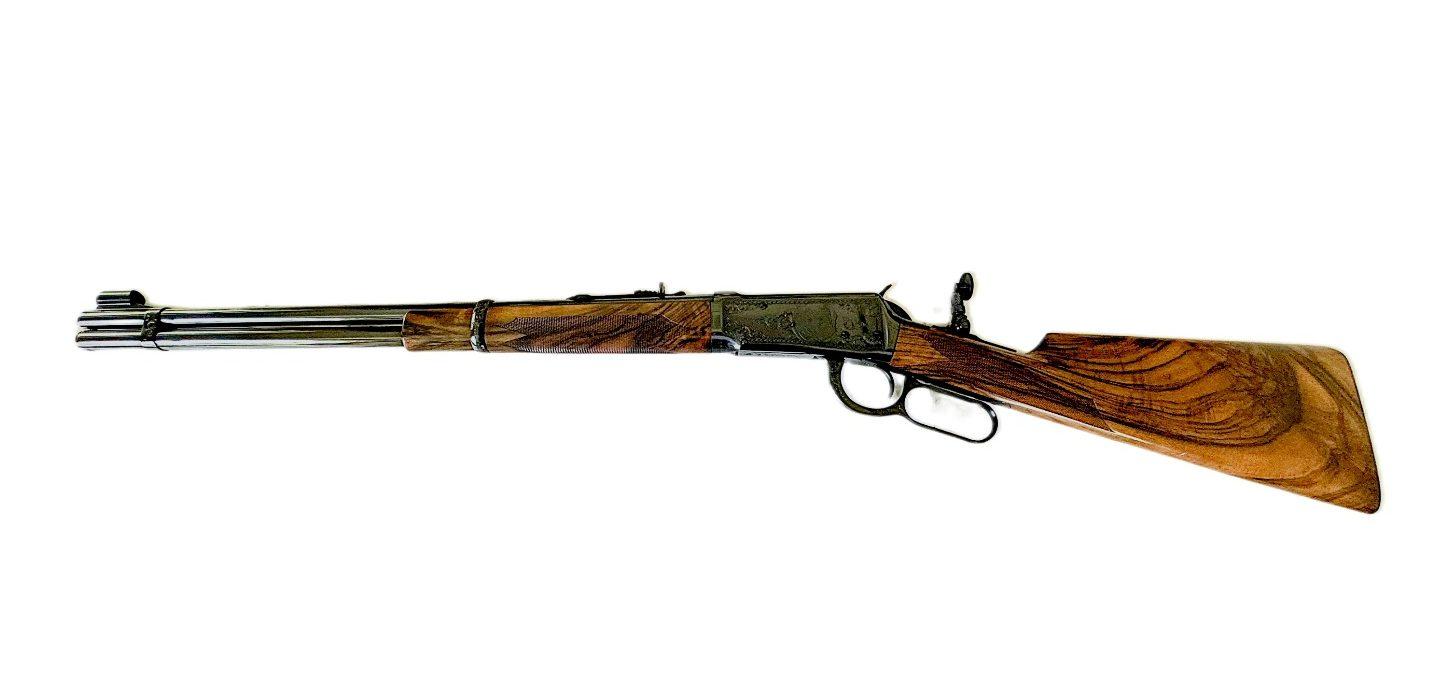
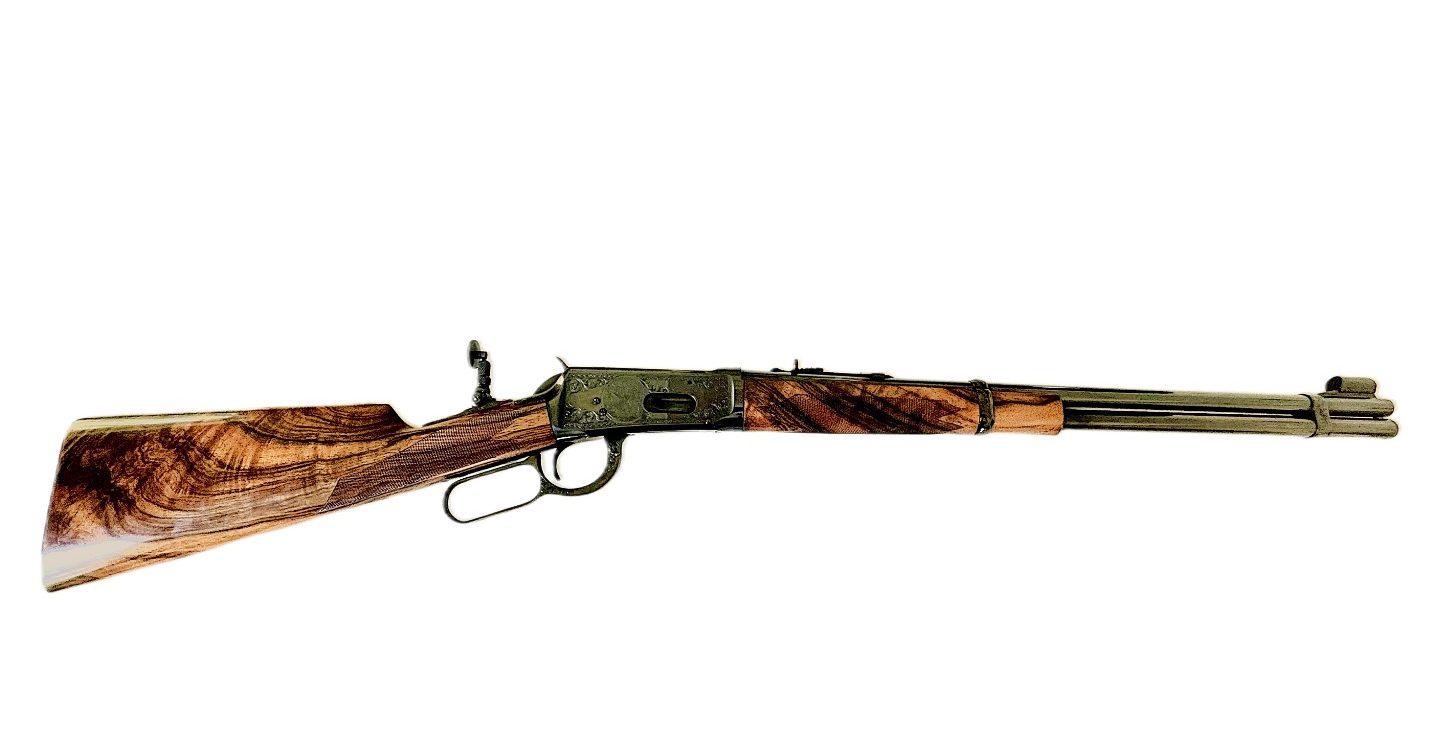
After contacting Joe by phone (Google his name and you'll find his business phone), we discussed my proposed project at length. He agreed to do it and told me it would likely take TWO YEARS! Nevertheless, I said okay and packed up the old '94 and sent it off to be reworked in late 2021. Now, any firearms expert will tell you that restoration is done to preserve the original character of a firearm and that any other customization detracts from value, something with which I strongly disagree and you'll see why. I wasn't interested in restoration; rather, I wanted a showpiece. Following is a general verbal description that was the scope of work I sent to Joe:
- 100 percent strip to bare metal and polish to the highest possible gloss surface.
- Engrave the receiver, bottom of the lever, and the ammo tube at 35% to 50% coverage, conventional fleur de lis type of engraving except the sides of the receiver which were to depict game animal scenes,
- Restock both the stock and forend with the absolute highest-grade exhibition walnut possible to buy and hand oil finished to high gloss. Hand checker to agreed specification per draft drawings we discussed.
- Create a completely new custom buttplate from steel and hand checker and engrave as agreed.
- Deep blue all metal parts using Colt Royal blueing (Winchester purists would find this sacrilegious until they see the finished product)
- Upon final assembly, test fire using Winchester 170 grain ammo to ensure functionality as well as regulating the iron sights and Marble Tang sight installed originally
Here are the results:
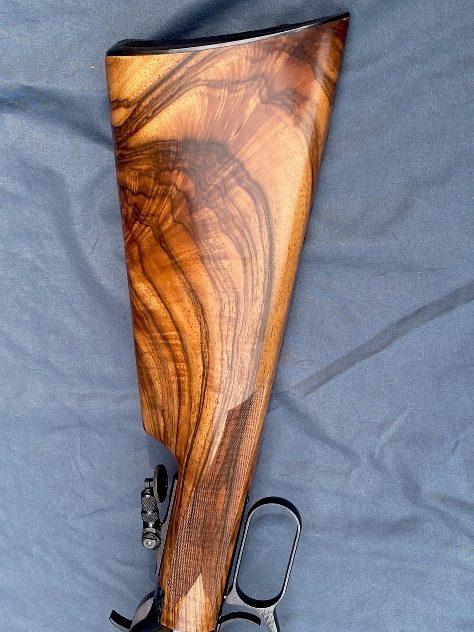
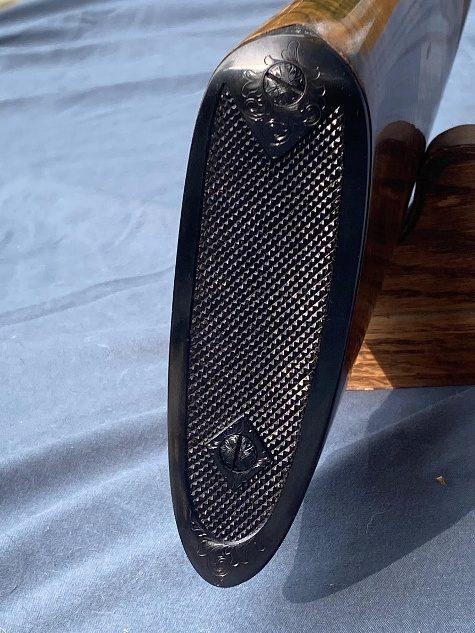
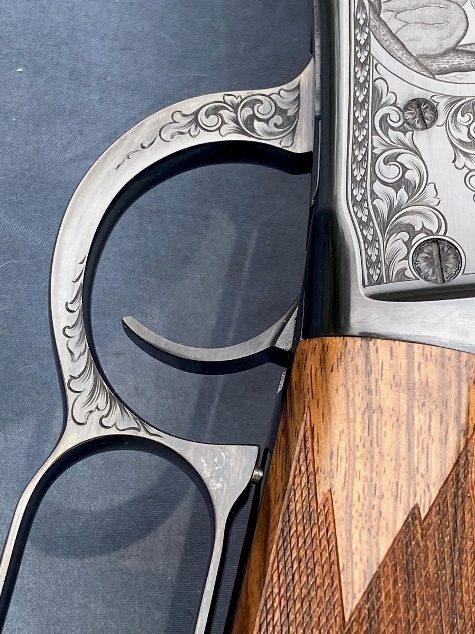
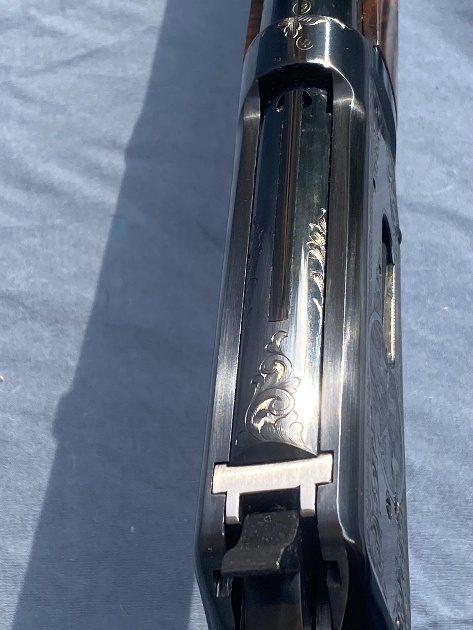
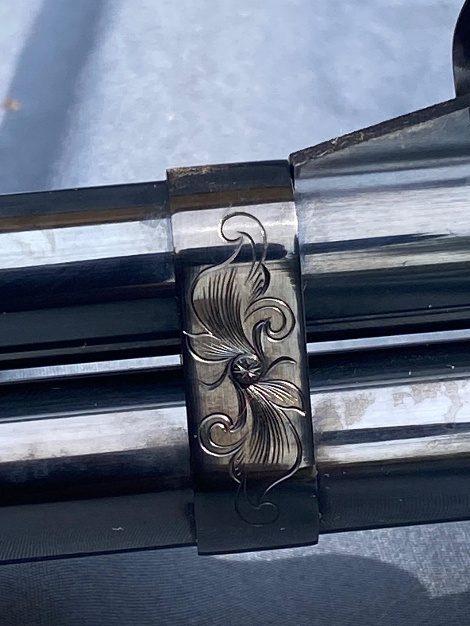
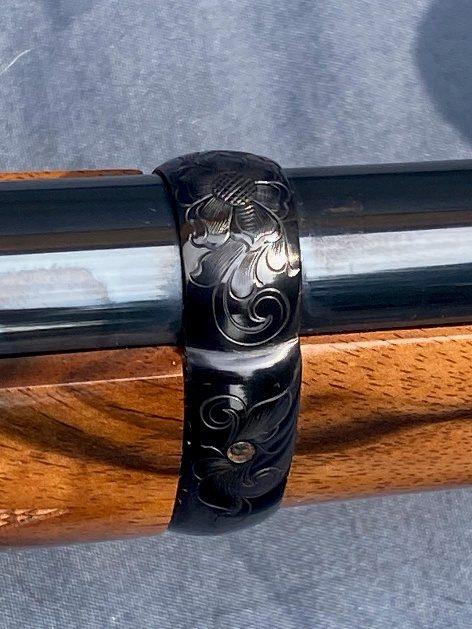
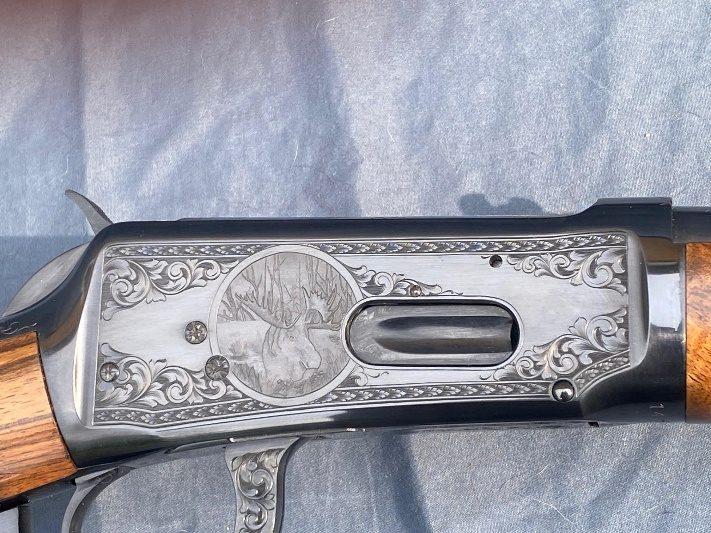
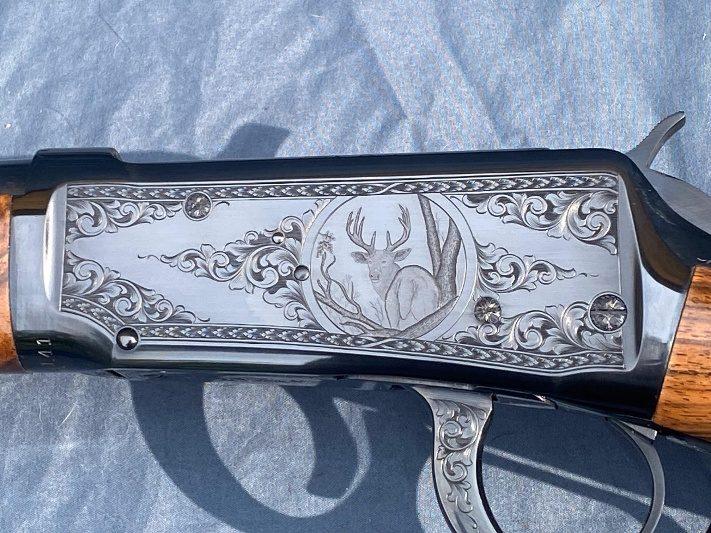
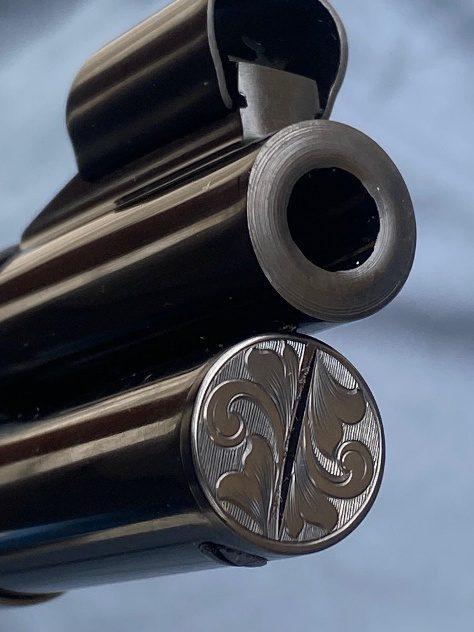
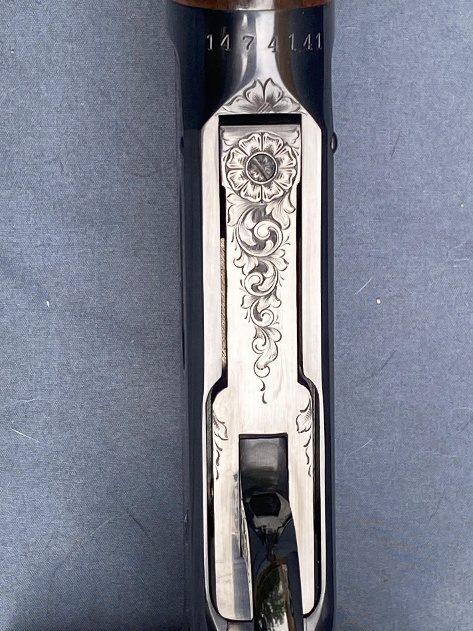
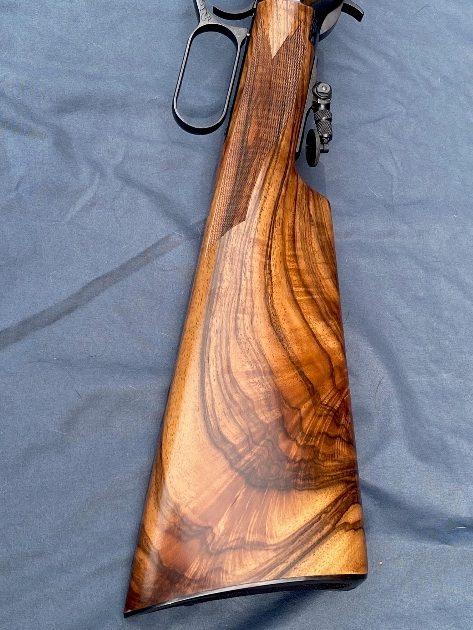
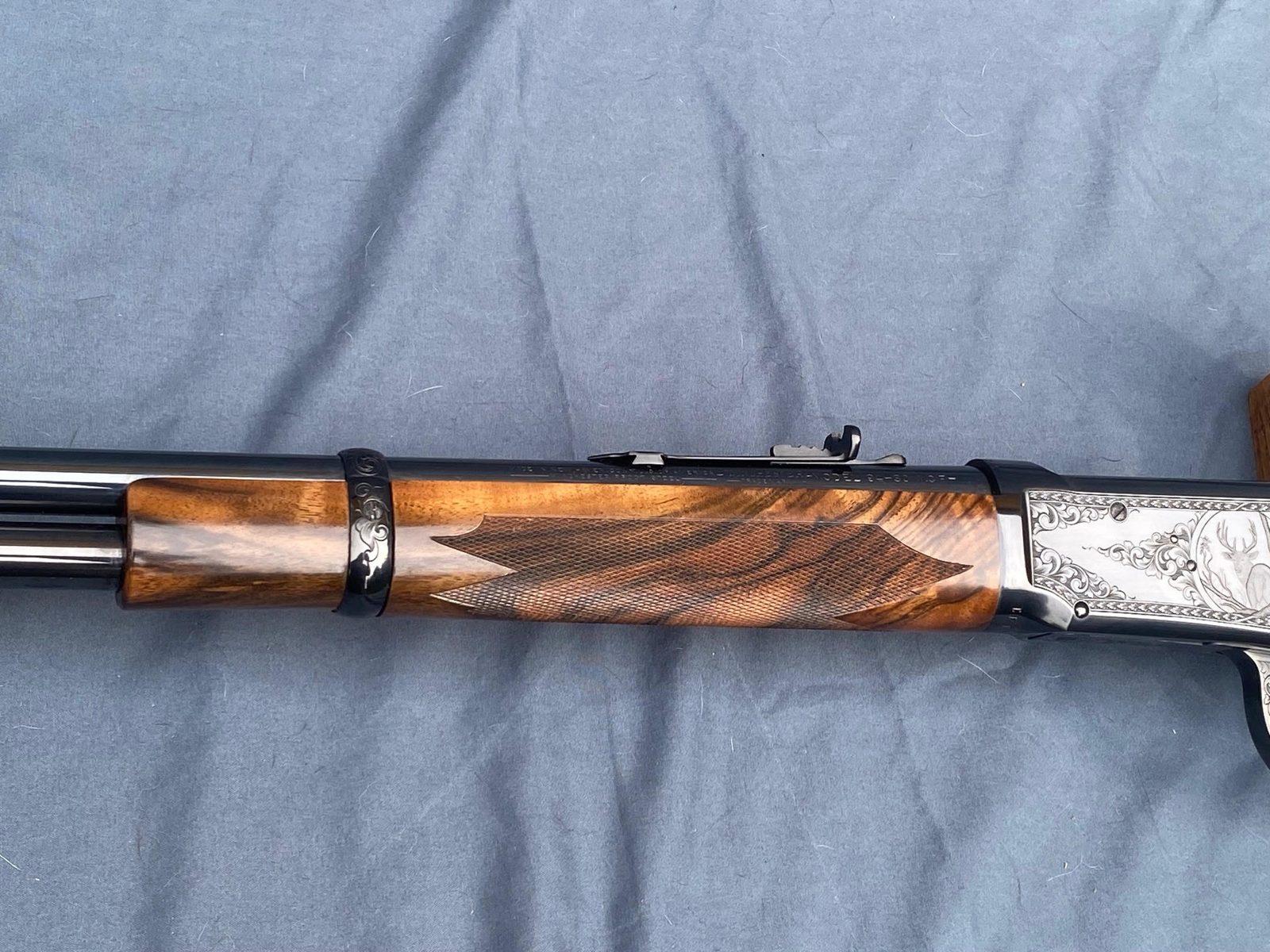
Sometime in the Fall of 2023, my wife and I happened to be in Western New York for a family member's wedding. After the event, we took a side trip to meet and visit Joe Seely at his workshop in Campbell, NY. At that point, my Winchester had been completely disassembled and stripped of all finishes, the original stock, forend, and buttplate had been discarded, and Joe had done only the rough cutout of the new stock and forend but had inletted the raw stock to begin fitting it to the receiver. I have to say, I did not in any way envision the finished product during our visit.
The final product was delivered to me on August 18, 2024, about two and a half years after I sent it to Joe. I did not receive any of the photos from Joe shown above prior to delivery. To say that opening the package revealed a breathtaking piece of work is an understatement! I was totally blown away by the final work.
As noted earlier, this is artwork, not restoration. Regrettably, I don't have a photo of the gun in its original configuration but essentially, it was just a plain jane dull old Winchester field gun (see the base model image below). The wood stock and forend were absolutely dull plain low- grade walnut. It surely is not that anymore.
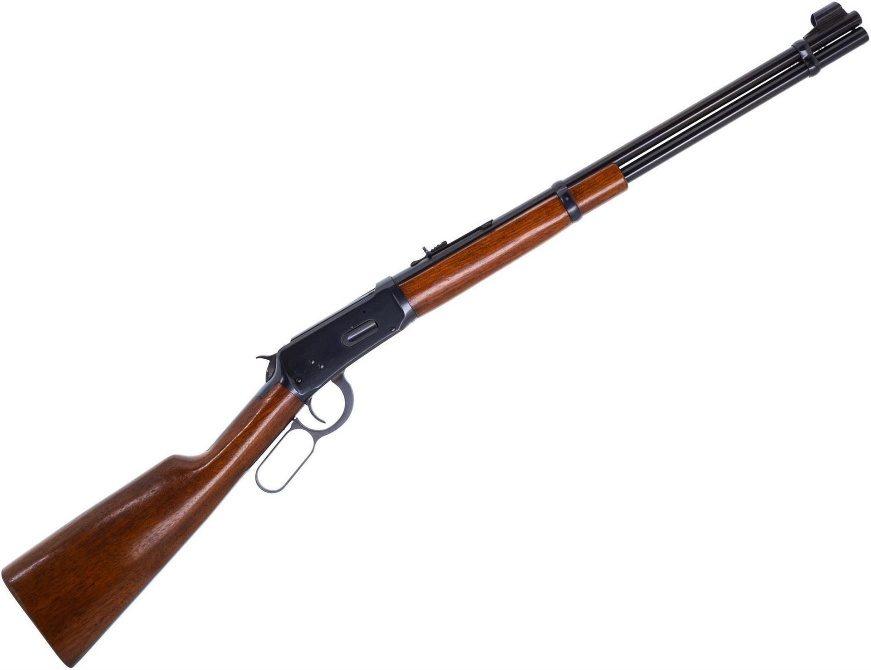
Unfortunately, my photo skills are lacking as these are the best photos I could take of the final product—Joe's detailed photos are much better—see below:
Joe Seely argued with me that this is a shooter and that I should treat it as such. That said, I told him that I have a number of collectible very high-end rifles and pistols, some of which have been shot plenty. This is absolutely not one of them.
So, what happens when I no longer am around to admire this beautiful rifle? While I'm not eager to leave this place anytime soon, the inevitable is inevitable. So, here's the deal: This rifle has been put in a trust. The trust will pass the rifle to my son. He is the 8th generation male in our paternal family line which began with our ancestor who came to this country in 1742 and subsequently fought in Washington's army for which he was awarded a grant of 2,000 acres in Pennsylvania and upon which he founded a town that exists to this day. Five generations of our paternal ancestors are interred in the town cemetery. Anyway, again, digression. Upon my son's passing, the trust requires that the Winchester pass to his first male heir, my now eleven-year-old grandson. Subsequently, to his son and so on until and unless there are no more male heirs. Should that occur, the firearm is to be donated to the Cody Firearms Museum (https://centerofthewest.org/cody-firearms-museum/) to be accompanied by a letter and documentation describing the rifle's origin and subsequent ownership and history. As far as diminishing the value of a firearm by "customizing" it, in this instance, I've taken a run of the mill, used base model 1894 Winchester worth a shade under $900 https://truegunvalue.com/rifle/winchester-1894-30-30/price-historical-value) and created a one-of-a-kind, highly desirable example of world class woodwork and engraving by a Master. I've accomplished my goal of creating a family heirloom that will speak to my descendants who will understand the provenance of this old gun and ensure it is handed down for generations. My grandson, by the way, has been told the story of this rifle and that it will one day be his to keep for his son and beyond. At 9 years old, he told me that he already has a name picked out for his son—the same name that I and 6 generations of men before me have honorably held. You can imagine my reaction.