Even good things don't last forever. This is one of them.
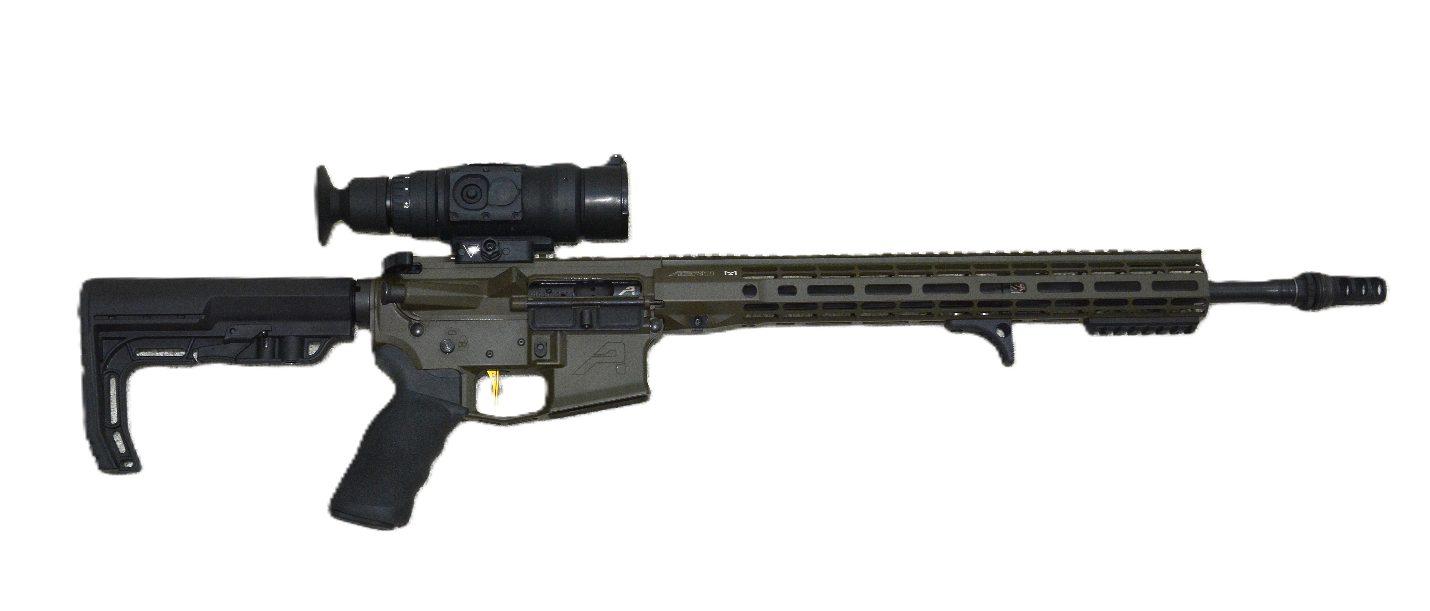
A few years ago, I decided to make a personal commitment to feral pig hunting. At night. That required an appropriate gun and thermal scope combination. I enjoy building AR-15's as many people do and, quickly ordered all the parts needed to build an AR chambered for the 6.5 Grendel cartridge.
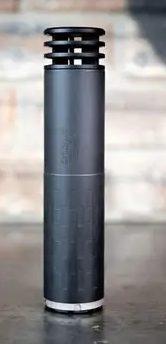
Rather than detail the entire parts list, I'll just say Aero Precision receiver set, AR Gold trigger and fire control group, Wilson Combat barrel with a SilencerCo ASR flash hider/suppressor mount. I always put a SilencerCo Omega 300 on this gun.
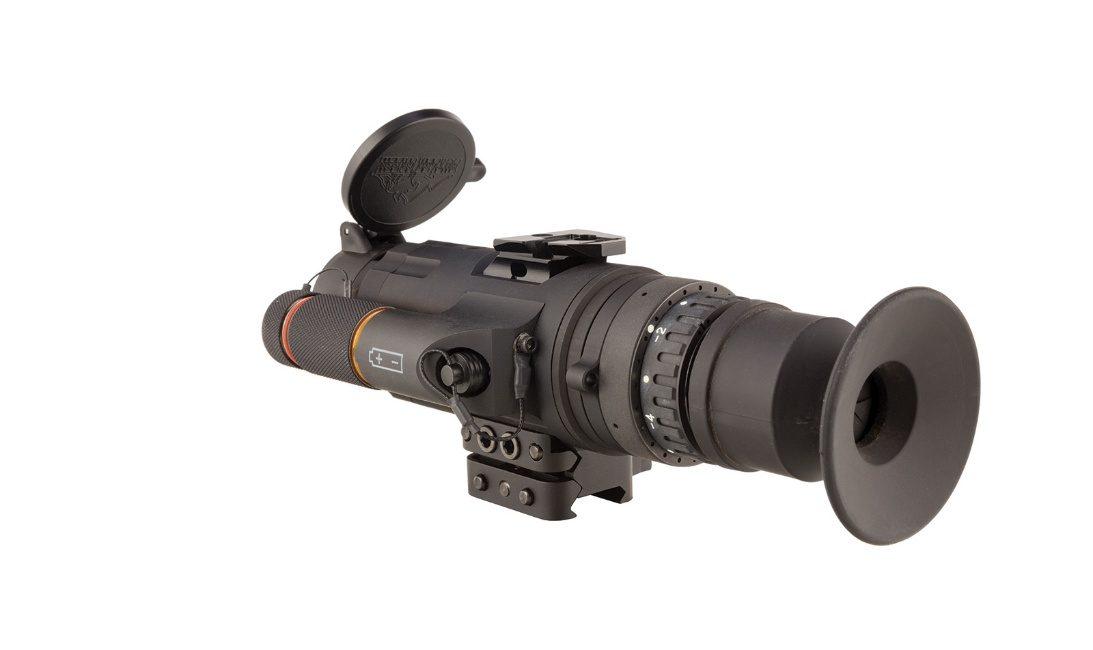
The thermal scope was the commitment test. It is and remains a REAP-IR 35mm thermal scope.
The photo below gives a clearer look at this device. It was a $7,000 price tag. But as I said earlier—I was committed.
Once I got this setup put together, I acquired a few different commercial loads to try. The story is short. Hornady 123 SST ammo grouped sub-MOA in five-shot groups over and over.
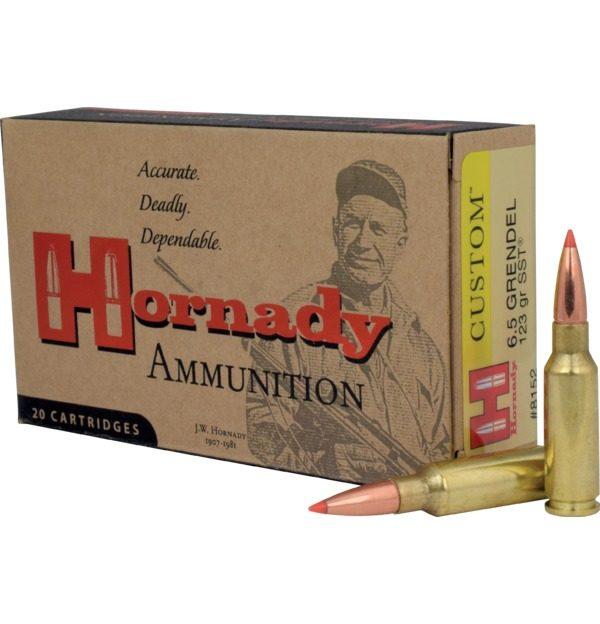
Super accurate from the 16" barrel at about 2400 feet per second. This is good stuff in a gas gun. Suppressed, this rifle is not silent but I easily go with only foam ear plugs when we hunt at night. And recoil is minimal.
The Grendel concept originally sought to address the bullet weight shortcomings of the 5.56 NATO round which is standardized at 55, 62, and 77 grains. It does indeed surpass the performance of 5.56 in terms of kinetic energy at the muzzle and at every yardage thereafter. Moreover, the Grendel is workable out to about 700 yards before it starts going transonic. The light 5.56 bullets may be screamers at the muzzle but they lack the energy of the Grendel. That's not to say that 5.56 is ineffective. It is, in fact, the single most popular cartridge in the USA, in both 55 and 62 grain loadings. I've shot many a pig with 5.56 rounds but there too much wounding and follow-up shots with that round. The Grendel hits a pig behind the ear and that's that. All done.
After going through the work of finding an accurate factory load, I worked to refine the zero of the thermal scope and which reticle would be best for my purposes—there are multiple user-selectable reticles in the Trijicon. The Trijicon also offers a 1.7 base magnification that is optically and digitally zoomable to 14x which, for the typical pig hunt distance, is more than adequate. The more you zoom, the less the image resolution but in no instance did I find the resolution to be problematic. It is a bit of challenge to use a thermal scope in the daytime when it's hot, particularly trying to use paper zeroing targets. But success was had in the end and I was zeroed at 200 yards. The reason for the zero at 200 was that it gave me the closest thing to a Point-Blank Range setting for every distance out to 225 yards. As virtually all of our shooting while pig hunting is offhand with sling support at best, it's a good idea to have a zero that offers this flexibility and yet a little room for error.
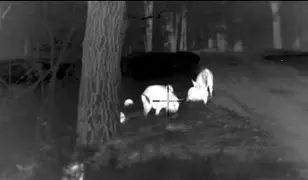
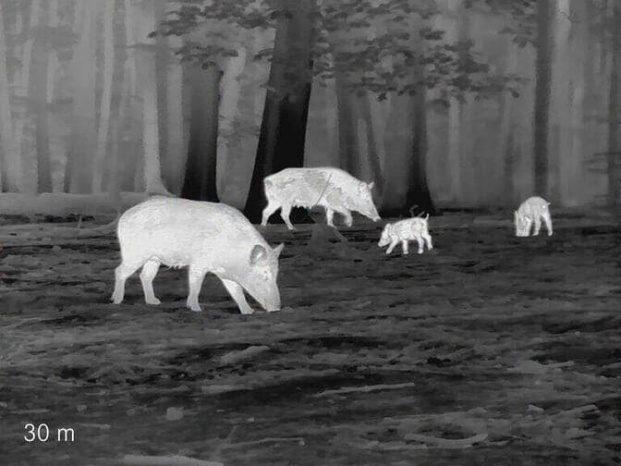
Testing complete, it was time to take to field. I did so one night with a friend and a guy that had access to a lot of acreage that was infested with pigs. We did a lot of walking that evening before we encountered a sounder of about 30 pigs of all sizes. Fortunately, we were downwind of them and were able to very quietly approach to within a hundred yards. At that point, we feared they would bolt at the slightest sound so my friend whispered, "On three. ONE, TWO, THREE! We had previously agreed that we would shoot any pigs we encountered such that the person on the right would shoot to the right, the middle man to the middle, and the left guy would keep left. This gave us the best chance to not shoot the same pig as someone else. As it turns out, that is exactly how it worked out. One pig each went down but before we could get another shot off, the remaining pigs had already fled into the adjacent woods. Pigs are not slow when they bolt!
After about three hours or walking and successful encounters which became trudging, we headed back to our vehicle. In total, we had killed 11 pigs.
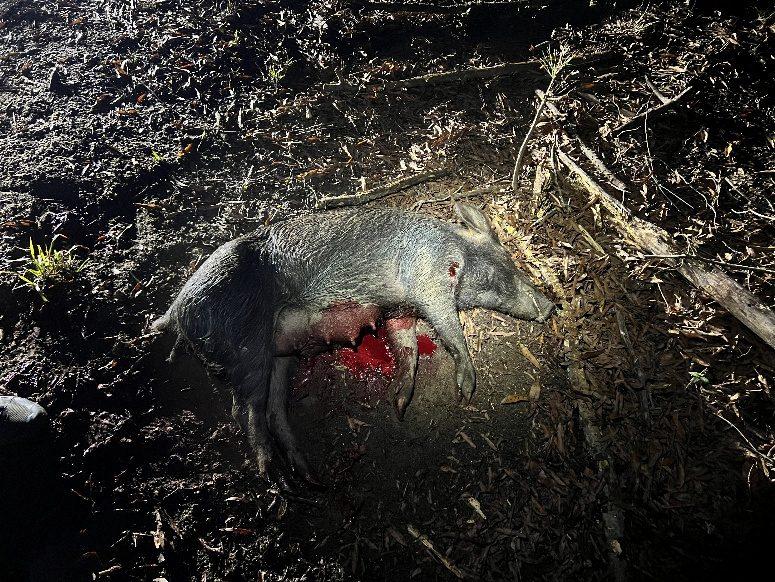
I doubt we made much of a dent in the population on the 12,000-acre parcel on which we had permission to hunt. Nevertheless, the Grendel was blooded. It has accounted for well over a hundred pigs since it made its debut. The Trijicon has been super reliable and I didn't think I'd ever likely replace it—that is, until the .338 ARC subsonic was invented. You can read about that here. The Grendel remains a reliable partner but, all good things come to an end. I have lots of Hornady 123 SST on the shelf but it, like the rifle, has been sidelined for at least awhile.